

Bain Technology Consulting Alternatives: Choosing the Right Advisory for 2026
Choosing a technology advisory partner is less about finding the most recognizable name and more about selecting the right model for the decision your organization needs to make.
Bain & Company serves large enterprises facing complex strategy, transformation, and organizational challenges. For many multinational companies, that global scale and breadth can be valuable.
Other organizations have different needs.
A mid-market financial services firm may need direct access to an experienced technology executive. A growing wealth management firm may need clarity on data, governance, cybersecurity, or AI readiness. A private equity-backed company may need an objective assessment before making a major investment. Another organization may already know what needs to change but lack the leadership capacity to guide execution.
These situations do not always require a global strategy firm.
The right alternative depends on your organization’s size, operating model, regulatory environment, internal capabilities, and the decisions leadership needs to make.
This guide explains the primary Bain technology consulting alternatives and provides a practical framework for choosing the model that best fits your business.
Key Takeaways
Bain, McKinsey, and BCG are well suited to large-scale enterprise strategy and transformation programs.
Accenture and the Big Four offer broad implementation, integration, and managed service capabilities.
Specialized executive advisory firms provide direct senior involvement, industry context, and more focused engagements.
An executive assessment can be the right starting point when leadership needs objective clarity before committing to a major initiative.
Ongoing executive advisory or fractional leadership may be appropriate when the organization needs sustained decision support and execution governance.
The best advisory model depends on your business problem, not the prestige of the provider.
Why Organizations Consider Bain Technology Consulting Alternatives
Companies typically begin evaluating alternatives when the traditional global consulting model does not align with their scale, budget, urgency, or operating needs.
This does not mean the larger model is ineffective. It means it may be designed for a different type of organization.
Large strategy firms often support:
Enterprise-wide transformation
Global operating model redesign
Corporate portfolio strategy
Large-scale cost or performance programs
Board-level strategic planning
Cross-border organizational change
These engagements can require large teams, extended discovery periods, multiple workstreams, and significant internal coordination.
A mid-market organization may need something more focused.
Leadership may need an independent answer to questions such as:
Are our technology investments aligned with the business strategy?
Can our current systems support the next phase of growth?
Is our data environment ready for AI adoption?
Are cybersecurity risks visible at the executive level?
Do we have the right technology operating model?
Are vendors accountable for measurable outcomes?
What should we prioritize over the next 90 days?
These questions require senior judgment, evidence-based analysis, and a clear path to executive action. They do not always require the scale of a global consulting firm.
Understanding the Main Technology Advisory Models
The market contains several distinct advisory and delivery models. Each one serves a legitimate purpose.
The key is understanding which problem each model solves best.
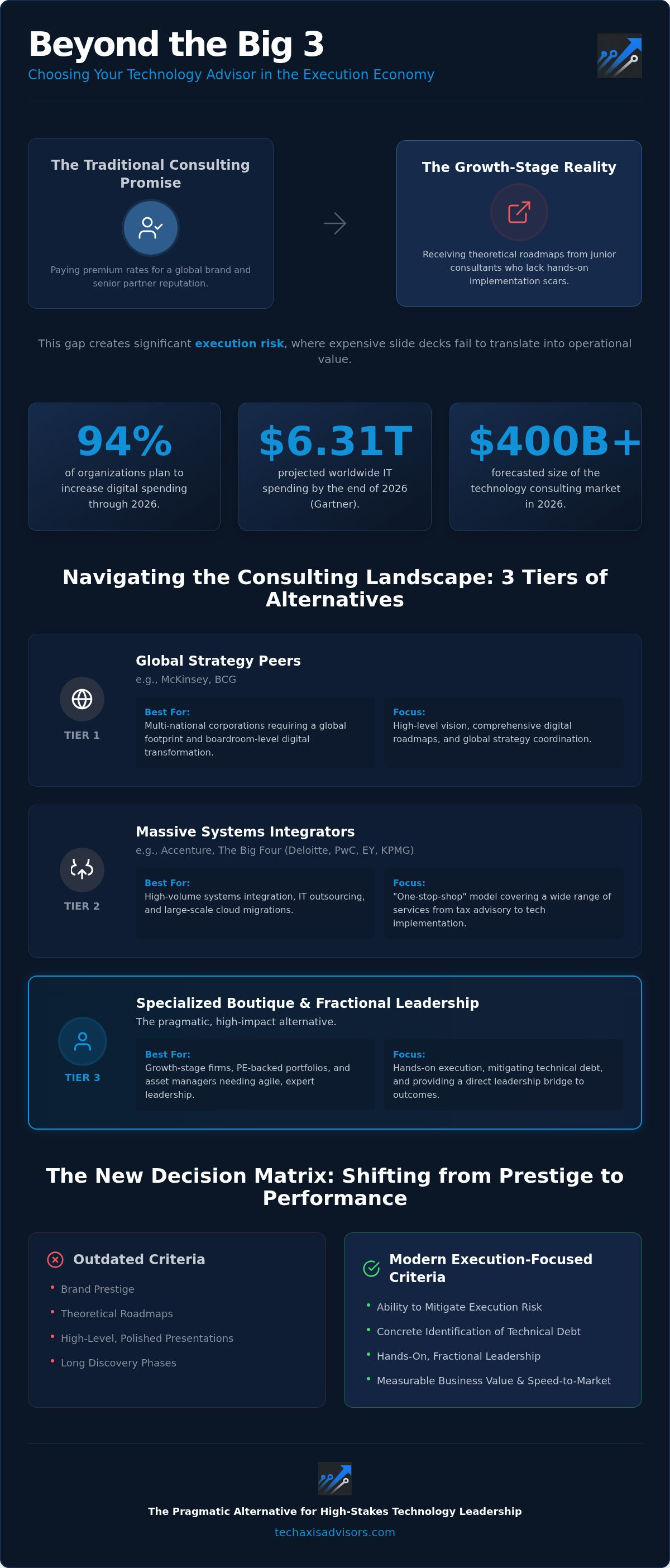
Global Strategy Consulting Firms
This category includes Bain, McKinsey, and Boston Consulting Group.
These firms are typically strongest when an organization needs:
Enterprise strategy
Global transformation planning
Large-scale organizational redesign
Cross-functional operating model work
Board and investor alignment
Broad market and competitive analysis
They bring significant research capability, established methodologies, and access to large multidisciplinary teams.
This model can be appropriate for multinational companies, major institutions, and organizations undertaking transformation across several business units or geographic regions.
Potential limitations for smaller organizations include higher costs, larger engagement structures, and less direct involvement from the senior leaders who initially shape the work.
Large Technology Integrators and Big Four Firms
This category includes Accenture, Deloitte, PwC, EY, KPMG, IBM Consulting, and similar providers.
These firms combine advisory services with substantial implementation capacity.
They are often a good fit when an organization needs:
Enterprise platform implementation
Cloud migration
Systems integration
Managed technology services
Cybersecurity implementation
Large application modernization programs
Global delivery capacity
Their primary advantage is breadth. They can provide strategy, architecture, implementation, program management, and operational support within one organization.
The tradeoff is that large delivery models can introduce more layers, larger teams, and greater coordination requirements. Companies should confirm who will lead the engagement, who will perform the day-to-day work, and how decisions will be escalated.
Specialized Technology Advisory Firms
Specialized firms focus on defined industries, company sizes, or technology challenges.
They may concentrate on areas such as:
Financial services technology
Wealth management platforms
AI readiness and governance
Cybersecurity and technology risk
Data and analytics strategy
Technology operating models
M&A integration
Executive technology leadership
These firms often provide greater access to experienced practitioners and can structure engagements around a specific executive decision.
Their value comes from focus.
A specialized advisor may not have thousands of consultants, but the client may work directly with a seasoned executive who understands the industry, operating environment, and consequences of the decision.
This model is often effective for mid-market organizations that need senior expertise without a large consulting structure.
Fractional and Embedded Executive Leadership
Fractional CIO, CTO, and CISO models provide ongoing executive leadership without requiring a full-time hire.
This model can be appropriate when:
The organization lacks senior technology leadership
Multiple technology initiatives require executive oversight
Vendors are driving decisions without sufficient governance
A major transformation needs accountable leadership
The company is between executive hires
Technology decisions are becoming business bottlenecks
Fractional leadership is different from a one-time assessment.
An assessment provides objective findings and a roadmap. Fractional leadership helps the organization make decisions, govern priorities, align vendors, and maintain execution momentum over time.
Not every company needs a fractional executive. Some need a focused assessment. Others need ongoing advisory support. The engagement should match the actual leadership gap.
How to Evaluate Bain Technology Consulting Alternatives
A credible selection process should evaluate more than firm size and brand recognition.
Use the following criteria.
Define the Executive Decision
Start with the decision leadership needs to make.
For example:
Whether to replace a core platform
How to govern enterprise AI adoption
How to improve executive reporting
Whether the organization is ready for an acquisition
How to reduce cybersecurity exposure
How to restructure technology governance
Which modernization investments should be prioritized
A vague objective produces a vague engagement.
Before evaluating firms, define the business decision, expected outcome, executive sponsor, and timeframe.
Determine Whether You Need Assessment, Strategy, or Execution
These are different needs.
An assessment helps leadership understand the current state, risks, gaps, and priorities.
A strategy engagement defines the future direction and investment roadmap.
Execution planning translates the strategy into architecture, sequencing, ownership, governance, and vendor decisions.
Execution leadership supports the organization while the roadmap is implemented.
Many consulting engagements underperform because the buyer has not distinguished between these needs.
A company asking for “technology strategy” may first need objective evidence about its current environment. Another may already know the problem and need execution governance rather than another diagnostic.
Evaluate Senior Involvement
Ask who will perform the work.
Confirm:
Who will lead stakeholder interviews
Who will evaluate the evidence
Who will develop the recommendations
Who will present to leadership
Who will remain involved after delivery
A firm’s brand matters less than the experience of the people assigned to the engagement.
For executive-level technology decisions, leadership should have direct access to professionals who have managed technology, data, cybersecurity, governance, vendors, and transformation in operating environments.
Assess Industry and Regulatory Context
Industry experience matters when technology decisions intersect with regulation, fiduciary obligations, client data, cybersecurity, and operational risk.
For wealth management and financial services organizations, an advisor should understand issues such as:
Client and advisor data
SEC and regulatory expectations
Cybersecurity governance
Third-party risk
Platform integration
Reporting reliability
AI oversight
M&A and advisor onboarding
Business continuity
Generic technology knowledge may not be enough.
The advisor should understand how technology decisions affect clients, operations, compliance, executive accountability, and growth.
Examine the Assessment Methodology
An effective executive assessment should not depend on opinion alone.
Look for a structured methodology that includes:
Defined assessment domains
Stakeholder interviews
Document and evidence review
Current-state validation
Risk and maturity analysis
Prioritized findings
Business impact analysis
A strategic roadmap
Clear ownership and next actions
The final output should support executive decision-making.
It should not be a collection of observations without prioritization, evidence, or accountability.
Evaluate Independence
Advisory recommendations should reflect the client’s business requirements.
Ask whether the firm:
Receives commissions from technology vendors
Resells recommended platforms
Has implementation incentives that may influence the assessment
Maintains partnerships that could affect objectivity
Can compare options without a predetermined outcome
Implementation partnerships are not automatically a problem. They can create useful delivery capacity.
The important issue is transparency.
Leadership should understand whether the advisor is providing an independent recommendation, an implementation service, or both.
Consider the Path Beyond the Assessment
An assessment creates value only when leadership acts on the findings.
Ask how the advisor supports the next phase.
This may include:
Executive decision support
Strategic roadmap development
Vendor evaluation
Program governance
Fractional technology leadership
Cybersecurity oversight
AI governance
Data and reporting strategy
M&A integration leadership
The advisor should not force the organization into a larger engagement. However, leadership should have a clear option for continuity when the findings require sustained executive involvement.
When a Specialized Executive Advisory Firm Is the Better Fit
A specialized advisory model may be more appropriate when your organization:
Is mid-market rather than multinational
Needs direct access to senior expertise
Operates in a regulated environment
Requires a defined assessment rather than a broad transformation program
Needs an objective evaluation before making a major investment
Has limited internal technology leadership
Needs clearer executive visibility into technology, data, AI, or cybersecurity
Wants a practical roadmap tied to business priorities
Needs continued support through execution
This model is not a smaller version of a global consulting engagement.
It is a different structure.
The engagement is usually narrower, more senior-led, and designed around a specific executive decision.
When a Global Firm May Still Be the Right Choice
A larger consulting firm may be the right option when:
The program spans multiple countries or business units
The organization requires hundreds of implementation resources
The initiative includes broad corporate restructuring
The board requires a globally recognized strategy partner
The company needs industry benchmarking across a large international dataset
The engagement requires several specialized practices working simultaneously
The objective is not to avoid large firms. It is to select them when their scale creates meaningful value.
Using a global provider for a focused mid-market assessment can create unnecessary cost and complexity. Using a small boutique for a large multinational transformation may create delivery risk.
Fit matters.
A Practical Four-Step Selection Framework
Step 1: Define the outcome
Document the decision, business objective, risk, timeframe, and executive sponsor.
Step 2: Select the engagement type
Decide whether you need an assessment, strategic roadmap, execution plan, implementation provider, or ongoing executive leadership.
Step 3: Evaluate the delivery model
Compare senior involvement, industry experience, methodology, independence, implementation capacity, and governance.
Step 4: Confirm the next-step pathway
Understand what happens after the initial engagement and how recommendations will translate into action.
How TechAxis Advisors Approaches Executive Technology Decisions
TechAxis Advisors works with executive leadership teams navigating growth, AI adoption, modernization, cybersecurity risk, data fragmentation, and technology operating complexity.
The firm focuses on executive decision-making rather than technology for its own sake.
Engagements can begin with one of six Executive Intelligence Assessments:
Executive Technology Assessment
Executive AI Readiness Assessment
Executive Data and Analytics Assessment
Executive Cybersecurity and Technology Risk Assessment
Executive Technology Operating Model Assessment
Executive Digital Transformation Assessment
Each assessment is designed to provide leadership with objective, evidence-based clarity.
The process evaluates the current state, validates findings, identifies business impact, and translates the analysis into prioritized executive action.
Typical deliverables include:
An Executive Assessment Report
An Executive Findings Summary
An Executive Strategic Roadmap
An Executive Action Register
An executive presentation and working session
Beyond the assessment, TechAxis can support leadership through executive advisory, strategic roadmaps, vendor and program oversight, and fractional technology leadership.
The objective is to help executives make confident technology, data, AI, cybersecurity, and transformation decisions, then maintain alignment as those decisions move into execution.
Choosing the Right Advisory Partner
There is no universal best technology consulting firm.
There is only the provider that best matches your organization’s size, complexity, industry, leadership capacity, and current decision.
Bain and other global firms serve an important role in large-scale strategy and transformation.
Large technology integrators provide extensive implementation capacity.
Specialized executive advisory firms provide focused expertise and direct senior access.
Fractional leaders provide sustained executive ownership when internal capacity is limited.
The right starting point is often a clear executive question:
What decision does leadership need to make, and what evidence is required to make it confidently?
Once that question is defined, the right advisory model becomes easier to identify.
For organizations navigating technology, data, AI, cybersecurity, or transformation decisions, TechAxis Advisors offers a confidential executive conversation to determine whether an assessment, advisory engagement, or fractional leadership model is the right fit.
Frequently Asked Questions
What is the main difference between Bain and a specialized technology advisory firm?
Bain provides broad strategy and transformation services for large organizations. A specialized technology advisory firm typically focuses on a narrower industry, company size, or executive challenge. Specialized firms may provide more direct access to senior practitioners and structure engagements around a defined technology, data, AI, cybersecurity, or operating-model decision.
Are boutique advisory firms less capable than global consulting firms?
Capability depends on the assignment. A global firm may be better equipped for a large multinational transformation requiring hundreds of resources. A specialized firm may be better suited to a focused executive assessment, industry-specific advisory need, or mid-market leadership challenge. The correct comparison is fit, not size.
When should an organization begin with a technology assessment?
An assessment is appropriate when leadership lacks objective visibility into the current environment, risks, governance, capabilities, or investment priorities. It can help prevent the organization from committing to a platform, vendor, AI initiative, or transformation program before understanding the underlying issues.
What is the difference between executive advisory and fractional CTO leadership?
Executive advisory provides strategic guidance, independent perspective, and decision support. Fractional CTO leadership involves deeper and more sustained participation in governance, priorities, vendor management, executive alignment, and execution oversight. The required level of involvement depends on the organization’s internal leadership capacity.
What should financial services firms look for in a technology advisor?
Financial services organizations should evaluate industry experience, cybersecurity and risk knowledge, data governance expertise, regulatory awareness, platform understanding, executive communication skills, and the ability to connect technology decisions with business outcomes.
Can a specialized advisor support AI strategy?
Yes. A qualified advisor should evaluate more than AI tools. The work should include business alignment, data readiness, governance, risk, technology foundations, organizational capabilities, executive oversight, and adoption priorities. AI strategy should begin with readiness and governance, not product selection.
How should an organization compare advisory costs?
Compare the total value and scope rather than hourly rates alone. Consider senior involvement, engagement duration, deliverables, internal time required, implementation dependencies, ongoing support, and the cost of making the wrong decision. A lower-priced engagement can still be expensive if it produces unclear findings or creates additional work for leadership.



Comments