

When Does a Growth Company Need a Fractional CTO?
Updated: Jul 22
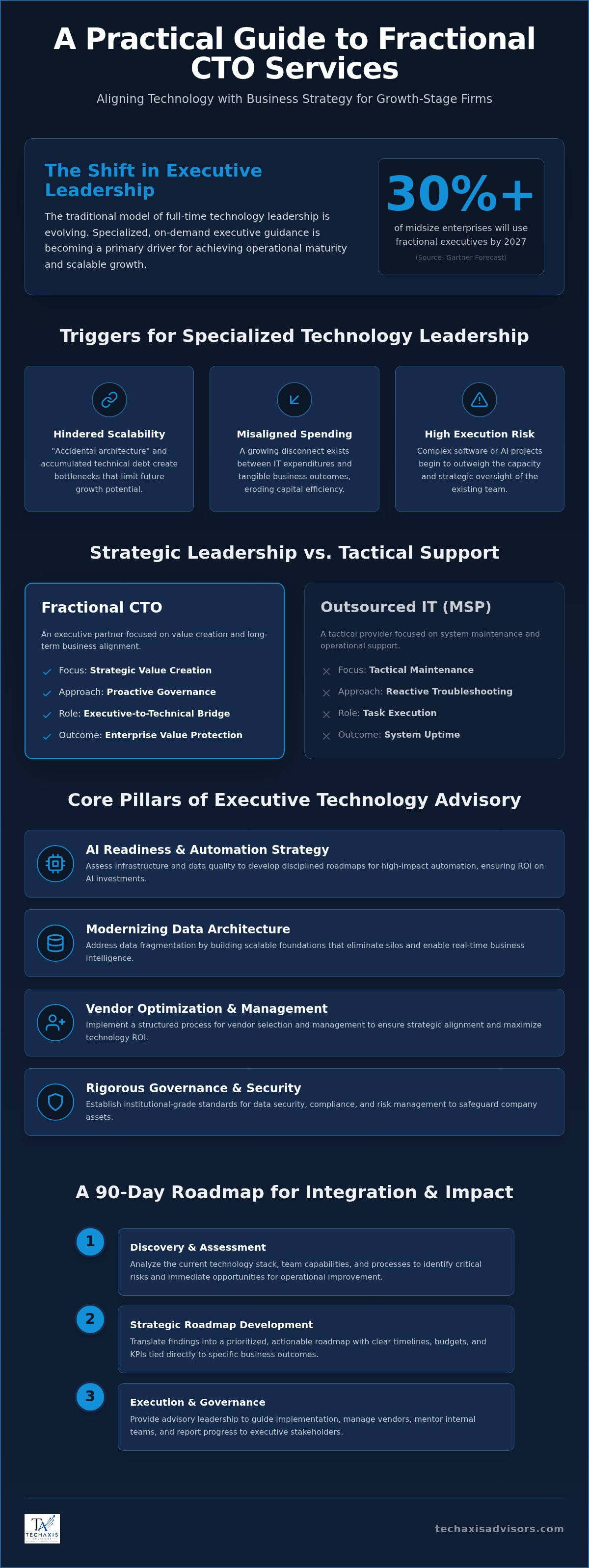
By 2027, Gartner forecasts that over 30% of midsize enterprises will utilize at least one fractional executive to steer their strategic operations. This shift indicates that the traditional model of full-time technology leadership is no longer the only path to achieving operational maturity. You likely recognize that technical debt is hindering your current scalability, or perhaps you feel a growing disconnect between your IT spending and actual business goals. It's a common inflection point where the execution risk of custom software projects and the complexities of AI implementation begin to outweigh the capacity of your existing team.
Engaging professional fractional cto services allows growth-stage firms to align operational execution with business strategy to reduce risk and accelerate growth. This article provides a clear framework to help you determine when your organization has reached the threshold for specialized technology leadership. We will examine the specific triggers for hiring, the trade-offs involved, and how a structured technology roadmap provides the executive clarity required to build scalable data and AI foundations.
Table of Contents
Defining Fractional CTO Services: Bridging the Strategic Leadership Gap
Growth-stage companies often reach a point where their technical infrastructure begins to outpace their strategic oversight. At this stage, leadership teams frequently mistake technical management for technology leadership. While a lead developer manages code, a Fractional CTO manages the intersection of technology and business value. These professionals serve as strategic executive partners who operate on a part-time or project basis, providing the same level of insight as a full-time executive without the associated overhead of a permanent C-suite hire.
The primary objective of fractional cto services is to ensure that every dollar spent on technology directly supports a specific business outcome. This involves more than just selecting software; it requires a deep understanding of operational maturity, risk mitigation, and capital efficiency. For many mid-market firms, this leadership fills a critical gap where technical debt has accumulated because decisions were made based on immediate needs rather than long-term scalability.
Strategic Advisor vs. Outsourced IT
It's vital to distinguish between a Fractional CTO and a Managed IT Service Provider (MSP). An MSP is primarily tactical. They focus on maintenance, help-desk support, and keeping existing systems operational. In contrast, fractional cto services are focused on value creation and strategic advisory leadership. While an MSP ensures your servers are running, a Fractional CTO determines if those servers should exist at all, or if a different architectural approach would better support your five-year growth plan.
The shift from reactive troubleshooting to proactive technology governance is a hallmark of professional advisory. Growth-stage firms don't just need more technicians; they need an architect who can design a system that scales alongside the business. This oversight includes establishing rigorous standards for data security, vendor management, and internal compliance.
The Role in Growth-Stage Evolution
Many companies begin with founder-led technology decisions. This works in the early days, but it often leads to "accidental architecture" that becomes a bottleneck during institutional scaling. A Fractional CTO helps navigate the transition from these informal beginnings to institutional-grade operations. They identify high-impact technology risks, such as data fragmentation or security vulnerabilities, before these issues derail a funding round or an acquisition.
By aligning technology initiatives with investment outcomes, these advisors provide the clarity required for complex decision-making. They act as a bridge between the board's vision and the engineering team's execution. A Fractional CTO is an executive partner who translates business objectives into disciplined technical roadmaps, effectively bringing order to technical chaos.
The Core Pillars of Executive Technology Advisory
Strategic technology leadership isn't a collection of disparate projects. It is a disciplined framework designed to support sustainable growth. For firms utilizing fractional cto services, the focus shifts from simply maintaining hardware to building an institutional-grade technology stack. This process centers on four critical pillars: AI readiness, data architecture, vendor optimization, and rigorous governance. Each pillar serves as a structural support for the broader business strategy, ensuring that technical execution never hinders operational goals.
AI Readiness and Automation Strategy
By 2026, AI integration will be a baseline requirement for competitive operations in the mid-market. However, effective adoption requires evaluating organizational readiness beyond the current market noise. A Fractional CTO assesses whether your existing infrastructure and data quality can actually support machine learning or large language models. In financial services, this means developing roadmaps for high-impact automation use cases, such as automated compliance monitoring or intelligent client onboarding. The goal is to improve operational efficiency through disciplined adoption, avoiding the waste of resources on experimental tools that don't produce a measurable return.
Modernizing Data Architecture
Data fragmentation is one of the most significant risks for wealth managers and asset managers today. When information is trapped in silos, leadership lacks the real-time business intelligence needed for informed decision-making. Professional advisory focuses on building scalable data foundations that unify reporting across the enterprise. This strategy reduces the reliance on manual spreadsheets and fragmented dashboards. It ensures that C-suite leaders have access to accurate, validated data that reflects the true state of the business. If your leadership team struggles with conflicting reports, it may be time to discuss a structured data assessment to regain clarity.
Beyond AI and data, executive advisory involves the active management of your technology ecosystem. This includes vendor and platform management to ensure that your technology spend is optimized and that service providers are held accountable to performance standards. Finally, cybersecurity and technology governance are integrated into every decision. This isn't just about software updates; it's about establishing the policies and oversight necessary for true operational maturity. These pillars transform technology from a cost center into a strategic asset that supports long-term valuation.
Strategic ROI: How Fractional CTOs Drive Enterprise Value
Many organizations view fractional leadership as a cost-saving measure. While the financial efficiency is clear, the real return on investment lies in the protection and enhancement of enterprise value. For a CEO or a private equity partner, technology is often the highest area of execution risk. A misaligned technology strategy doesn't just waste capital; it creates systemic bottlenecks that can stall growth or jeopardize an exit. Professional fractional cto services provide the oversight necessary to ensure that technical decisions are made with a clear understanding of their impact on the balance sheet.
The cost-benefit analysis of fractional expertise is compelling. Research indicates that a full-time CTO's fully loaded cost can range between $470,000 and $690,000 in the first year. In contrast, a fractional engagement typically costs between $60,000 and $180,000 annually. This delta allows growth-stage firms to reallocate significant capital into direct growth initiatives while still maintaining high-level strategic governance. The value is not just in the money saved, but in the avoidance of a $500,000 hiring mistake that fails to align with the company's long-term operating model.
Technology Due Diligence and Risk Mitigation
During high-stakes acquisitions or funding rounds, investors look beyond current revenue to assess the integrity of the underlying technology stack. A Fractional CTO conducts structured assessments to identify hidden technical debt that could impact operational maturity. They help build a technology operating model that supports institutional-grade scaling, ensuring the firm is "exit-ready" at any time. By addressing these risks early, leadership can defend a higher valuation and provide investors with the confidence that the platform is built on a stable, scalable foundation.
Wealth Management and Asset Management Specialization
For firms in regulated financial sectors, the ROI of professional advisory is tied directly to compliance and data integrity. Wealth managers face unique challenges in aligning client-facing tools with back-end operational efficiency. A Fractional CTO ensures that data strategy isn't just about reporting, but about meeting rigorous regulatory standards while reducing manual overhead. This specialization reduces technical execution risk in environments where a single data breach or compliance failure can result in significant financial and reputational damage.
By focusing on strategic technology services, firms can bridge the gap between their current state and their desired growth trajectory. This leadership provides a disciplined approach to vendor accountability and platform selection, ensuring that every technical initiative is an investment in future equity rather than a recurring expense.
Selection Criteria: Evaluating Fractional CTO Firms
Selecting the right partner for fractional cto services requires a shift from technical evaluation to strategic assessment. Many leaders mistakenly focus on a candidate's proficiency in specific coding languages or cloud platforms. While technical competence is foundational, it's the advisor's business acumen and industry-specific experience that determine the success of the engagement. You don't just need a technician; you need a peer who understands the mechanics of scaling a mid-market firm. They must understand how technology decisions impact your EBITDA, your valuation, and your long-term operational scalability.
One critical distinction to make is whether a firm offers a partner-led advisory model or a marketplace-style matching service. Marketplace models connect you with independent freelancers, which can lead to fragmented oversight and a lack of long-term accountability. A partner-led firm provides a structured framework and brings collective wisdom to your organization. It's also important to assess the firm’s ability to support execution through white-label software development partnerships. This ensures your roadmap is implemented through disciplined governance rather than unmanaged development teams. Finally, check for corporate status; working with a Certified Women-Owned Small Business (WOSB) can align with your corporate governance and supplier diversity initiatives.
Executive Presence and Strategic Alignment
The ideal advisor must possess the executive presence to speak the language of the C-suite and investors. They don't just report on technical metrics; they translate complex technical risks into clear business impact statements. If a software project is delayed, they explain the risk to the product roadmap and the potential impact on customer retention. This pragmatic, results-oriented commitment to execution ensures that technology remains a tool for business progress rather than a source of confusion. They should feel like a natural extension of your leadership team, not an outside consultant.
Operational Maturity Assessments
A professional firm begins by identifying gaps in your current technology operating model through a structured Executive Intelligence Assessment. This discovery phase is essential for designing a scalable technology roadmap that aligns with your specific business goals. Rather than offering abstract theory, the firm should provide tangible, evidence-based findings that support your leadership working sessions. The ideal Fractional CTO acts as a Strategic Architect who builds the structural integrity necessary for your company to scale with confidence. This architecture ensures that your systems, data, and teams are prepared for the next stage of institutional growth.
Implementing Fractional Leadership: A Roadmap for Success
Successful integration of fractional cto services depends on a disciplined onboarding process that prioritizes strategic alignment over immediate technical changes. The goal is to move from initial discovery to tangible operational improvements within a defined 90-day window. This period allows the advisor to establish a baseline for operational maturity and identify the most pressing risks to your 12-24 month business goals. It's not about replacing your current team; it's about providing the executive oversight they need to execute with confidence.
Phase 1: Discovery and Operational Audit
Technical debt stalls progress. Data silos hide truth. Misaligned spend drains capital. The first 30 days focus on a comprehensive Executive Intelligence Assessment to uncover these hidden bottlenecks. This phase includes a rigorous AI readiness and data strategy assessment to determine if your current infrastructure can support modern automation. By reviewing existing vendor platforms and technology governance frameworks, the advisor identifies the primary obstacle to your current scalability. This discovery ensures that the resulting roadmap is based on evidence rather than assumptions.
Phase 2: Execution and Scaling
Once the audit is complete, the focus shifts to disciplined execution. A Fractional CTO establishes a predictable cadence for technology oversight, ensuring that engineering teams and leadership remain in constant alignment. This often involves modernizing legacy reporting frameworks to provide the C-suite with accurate, real-time business intelligence. When new technical capabilities are required, the advisor facilitates the implementation of custom software solutions through trusted white-label partners. This model allows the firm to fulfill its technology roadmap through expert governance rather than unmanaged internal development.
Measuring the success of fractional technology leadership requires clear, outcome-based KPIs. These metrics should move beyond technical uptime to focus on business value. Effective indicators include the reduction of technical debt, the successful alignment of IT spend with strategic goals, and the speed of AI adoption within key departments. By setting these benchmarks early, leadership can ensure the engagement provides the executive clarity necessary for institutional-grade growth. This structured approach transforms technology from an unpredictable variable into a reliable engine for enterprise value.
Building a Scalable Technology Operating Model
Growth-stage firms don't need more technical maintenance; they need strategic architecture. Transitioning from founder-led tech to institutional-grade operations requires a disciplined approach to AI readiness, data integrity, and vendor accountability. Professional fractional cto services provide this executive oversight, ensuring that every technical decision aligns with your long-term valuation and business strategy. This leadership effectively bridges the gap between high-level vision and the mechanics of execution.
As a Certified Women-Owned Small Business (WOSB), TechAxis Advisors works with executive leadership teams in wealth management and private equity to provide clarity for complex technology decisions. We focus on building operational maturity and reducing execution risk through structured assessments and prioritized roadmaps. Whether you're assessing AI adoption or preparing for a funding round, the right advisory partner acts as a Strategic Architect for your success.
Securing your company's future starts with establishing a stable foundation today. You can move forward with confidence, knowing your technology is a driver of growth rather than a bottleneck.
Frequently Asked Questions
What exactly are fractional CTO services?
Fractional cto services provide strategic, executive-level technology leadership on a part-time or advisory basis. Unlike tactical IT management, this role focuses on aligning technology investments with business outcomes like risk reduction and operational growth. It's designed for firms that need the wisdom of a veteran executive but don't require a full-time, permanent presence to achieve their goals.
How does a fractional CTO differ from a full-time CTO?
A fractional CTO offers high-level strategic oversight without the permanent overhead of a full-time C-suite executive. While a full-time CTO is embedded daily, a fractional partner operates with a focused cadence, often averaging around 13 hours per week. This model allows growth-stage firms to access institutional-grade expertise at a significantly lower cost than a traditional, fully loaded executive hire.
When is the right time for a growth-stage company to hire a fractional CTO?
The right time often arrives when technical debt begins to hinder your ability to scale operations effectively. You might notice a disconnect between your technology spending and your actual business goals. If your engineering team has grown but lacks a clear strategic roadmap, engaging an advisor can provide the necessary structural integrity to move forward with confidence.
Can a fractional CTO help with AI strategy and implementation?
Yes, a fractional CTO is essential for evaluating organizational readiness for AI beyond the current market noise. They develop disciplined roadmaps for high-impact automation use cases, particularly in regulated sectors like financial services. Their focus remains on improving operational efficiency and reducing risk through evidence-based adoption rather than experimental tools that lack clear ROI.
Do fractional CTOs manage internal development teams?
Fractional CTOs typically provide advisory leadership and governance rather than direct, hands-on management of internal developers. They act as a Strategic Architect, bridging the gap between the board's vision and the technical team's execution. This approach ensures accountability and transparency without the advisor becoming a bottleneck in the daily technical tasks of the engineering organization.
How much do fractional CTO services typically cost?
The cost of these services depends on the scope of the engagement, the urgency of the firm's needs, and the complexity of the existing technology stack. Engaging a fractional leader is generally more capital-efficient than a full-time hire. This model allows leadership to reallocate resources toward direct growth initiatives while still maintaining professional technology governance and executive-level oversight.
How long do fractional CTO engagements usually last?
Engagements can be structured as short-term projects or long-term advisory roles. A typical initial roadmap spans 90 days to address immediate discovery and assessment needs. Many firms maintain the relationship for 12 to 24 months to oversee the implementation of long-term technology roadmaps and ensure sustained operational maturity as the company evolves.
What industries benefit most from fractional technology leadership?
Regulated mid-market sectors, such as wealth management and private equity portfolios, see the most significant impact from professional technology advisory. These industries face unique challenges regarding data fragmentation, cybersecurity, and compliance. Specialized leadership helps these firms align their client-facing technology with back-end operational efficiency while mitigating the execution risks common in highly regulated environments.



Comments