

Data analytics strategy for investment firms: Key decisions
More data doesn’t automatically improve investment decisions. A data analytics strategy for investment firms connects information and analysis to decisions across deal evaluation, portfolio oversight, and asset management.
The challenge is making data useful across internal systems, portfolio companies, and external sources. Without clear priorities, more data can add complexity without improving decision support.
This article explains how investment leaders can prioritize analytics, governance, and data sourcing, then align those choices with business objectives.
Table of Contents
Why is a Data Strategy Important?
Investment decisions depend on whether relevant information is available, consistent, and usable when teams need it. A data strategy connects those requirements to business priorities, such as evaluating a target, monitoring portfolio performance, or assessing market conditions. Without that connection, firms can add platforms and datasets without improving the decisions those investments are meant to support.
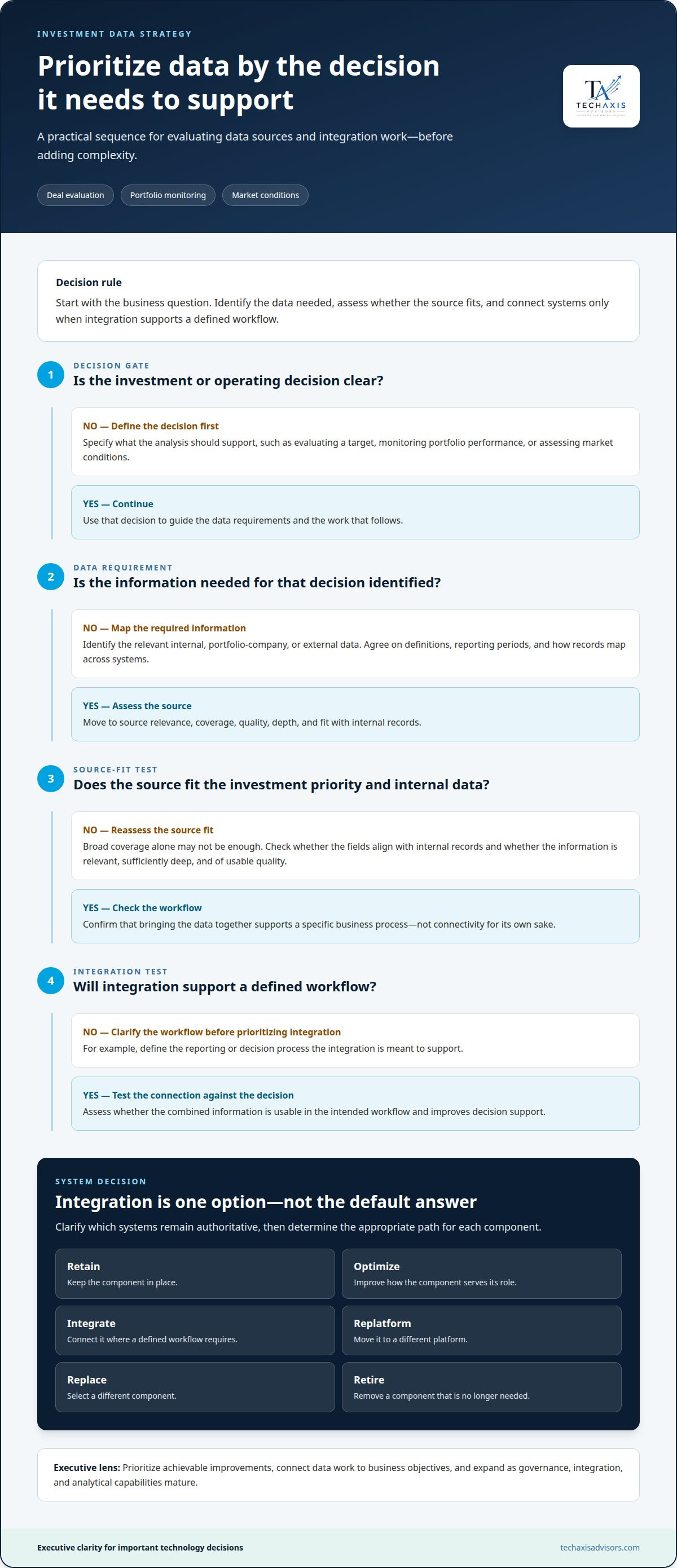
Legacy systems make the challenge operational. An asset manager may hold positions in one platform, client records in another, and research in shared files. Different formats and definitions complicate integration: the same company, instrument, or reporting period may appear differently across systems. Teams then spend time reconciling records before they can interpret performance. A strategy clarifies which systems remain authoritative, what needs to connect, and whether to retain, optimize, integrate, replatform, replace, or retire each component.
Data availability means more than having access to a source. A portfolio company may provide financial data, while operating metrics sit in its ERP and customer information resides in its CRM. Those sources become useful together only when owners agree on definitions, reporting periods, and how records map across systems. Integration should support a defined workflow, such as producing a consistent portfolio report, rather than pursue connectivity for its own sake.
Dataset selection also requires discipline. Investment teams should assess relevance to their thesis, coverage of the companies or markets they analyze, and the quality and depth of the information. An external dataset with broad coverage may still be unsuitable if its fields do not align with internal records. A practical sequence is to define the decision first, identify the data required, assess source quality, and then test whether integration supports that decision.
Post-acquisition integration adds another layer. When a private equity firm combines businesses, their systems may use different definitions for customers, products, and costs. A shared reporting model can create comparability while preserving company-level detail needed for operations. Finance leaders and portfolio-company data owners should establish common measures and source records before consolidating reports. Otherwise, apparent differences may reflect inconsistent definitions rather than actual performance.
Disconnected tools can also restrict availability across an organization. A team may have a useful analysis in a spreadsheet, but other decision-makers cannot reproduce it or trace its inputs. Centralized access and documented data flows help teams use information effectively while maintaining oversight. For wealth management and private equity organizations, the relevant operating context shapes which data access and integration priorities matter most.
The U.S. Government Accountability Office describes risk management as connecting strategic goals to plans and budgets, assessing investment alternatives, and using performance measures to evaluate outcomes. Applied to data, this means prioritizing integration work according to how it supports a business decision. The result is a clearer basis for allocating resources, sequencing improvements, and assessing whether data capabilities support investment objectives.
Predictive analytics for investment decisions
Predictive analytics uses historical and current information to estimate possible outcomes and inform investment choices. Portfolio, risk, and performance analysis can compare exposures, scenarios, and sources of return. Effective teams combine investment expertise with quantitative, data, and operational skills.
Analytics for Portfolio and Risk Decisions
Portfolio analytics evaluates holdings against investment objectives, while risk models estimate how exposures may behave under changing conditions. Performance attribution separates sources of return, helping teams distinguish security selection from broader market effects. Together, these analyses give investment committees a structured basis for assessing a proposed allocation or explaining results.
For example, an asset manager can compare a portfolio’s sector exposures with a market scenario before approving a rebalance. A risk team can test how interest-rate or customer-demand changes could affect underlying positions. Attribution can then show whether performance reflects allocation choices, security selection, or other measured factors. The analysis is useful only when its assumptions are clear and the model fits the decision.
Analytics should inform judgment, not replace it. Investment professionals need to understand a model’s inputs, assumptions, and limitations before acting on its output. A sound decision process identifies the question, selects relevant measures, reviews model results, and records how those results informed the decision. This makes analysis easier to challenge and promotes consistency across investment teams.
An effective operating model assigns responsibility across investment leaders, data specialists, and technology roles. Portfolio managers define the decision and interpret the findings. Quantitative analysts design and assess models. Data engineers prepare reliable inputs, while business owners oversee workflow adoption. These roles can sit in one team or work across functions, as long as accountability and decision rights remain clear.
Data-Driven Private Equity Decisions
In private equity, data-driven decisions connect analysis to action across deal evaluation, due diligence, investment growth, and portfolio monitoring. A clearly defined operating question helps teams focus models on evidence that could change an investment or operating choice, rather than producing analysis without a decision owner.
For a portfolio company, a team might model customer retention alongside revenue and service activity. The analysis could help operating leaders identify which customer segments warrant attention, then measure whether a chosen action changes the relevant indicators. The investment team must interpret the results in context: a model can identify patterns without establishing their cause.
Digitization requires investment in data preparation, analytical capability, and ongoing model oversight. The decision is not simply whether to adopt a tool. Leaders should weigh the effort required to maintain inputs against the expected usefulness of the analysis, including whether an existing workflow can support the use case. A narrowly scoped pilot can establish ownership, test adoption, and show what additional capability is justified.
Private equity teams can measure adoption and results against agreed business measures, then refine the approach as evidence accumulates. Operating partners, finance leaders, and portfolio-company owners each contribute distinct context. Discuss an analytics decision when leadership needs to clarify the operating question, capabilities, or model oversight required.
Data governance, stewardship, and lineage
Governance defines who may use investment data, how teams maintain it, and how they validate its quality. Clear ownership, access controls, quality checks, and model-validation processes help analysts assess data reliability and trace insights back to their sources.
Governance Policies and Data Standards
Governance policies establish consistent rules for handling data across investment teams and portfolio companies. They define access, shared metrics, quality checks, and accountability. For example, finance and operating teams can agree on revenue definitions and reporting periods before comparing acquisition performance. Shared standards make outcomes easier to interpret and help prevent conflicting patterns across reports.
Compliance considerations should inform those policies from the start. Governance plans can account for applicable data standards and obligations, depending on the firm's data. A policy should identify relevant information, permitted access, and responsible owners. It should also explain how teams document decisions, escalate quality issues, and retain information needed for ongoing analysis.
The U.S. Environmental Protection Agency says information analysis plans should specify how data will be collected, maintained, made accessible after a project, and quality-assured. The same principle helps investment firms define repeatable controls. For instance, an analysis supporting a portfolio review should document its source records, collection method, and quality criteria. Teams can then assess whether later reports use comparable inputs.
Stewardship, Lineage, and Data Quality
Data stewardship assigns responsibility for definitions, access, and quality, while lineage records how information moves from source to report. These controls matter when an investment committee needs to explain a portfolio insight or trace a metric to its underlying records. A named steward can resolve disputes about definitions and coordinate corrections when source data changes.
Consider a portfolio company that reports customer churn from its CRM while finance tracks revenue in an ERP. A steward aligns the relevant definitions and establishes which records feed each measure. Lineage then shows how source fields were transformed into a management report. If churn patterns change, analysts can distinguish business movement from a changed formula or incomplete update.
Quality controls should focus on the data elements that affect decisions. Teams can define checks for missing values, inconsistent dates, duplicated records, and unexpected changes, then assign an owner to resolve exceptions. Model validation adds a separate review: teams examine inputs, assumptions, and outputs against the intended use. For example, a risk model used in portfolio oversight should be reviewed to confirm its data and assumptions remain appropriate.
For a private equity acquisition, stewardship can clarify which company records support shared reporting and which remain specific to local operations. Documented lineage helps finance leaders reconcile consolidated figures with company-level detail. Together, ownership, quality checks, access controls, and validation give decision-makers a clearer basis for using analytics and explaining its outcomes.
Data strategy and value-creation priorities
An effective investment-firm data strategy connects business objectives, priority decisions, data requirements, governance, delivery, and success measures. Work typically moves from defining a priority to assessing data and workflows, delivering an initial use case, and refining the roadmap. Timing depends on access, data quality, and integration needs.
Value-Creation Priorities for Data Strategy
Value-creation priorities determine which data capabilities merit investment and which decisions they should improve. For an investment firm, objectives may include deal sourcing, due diligence, portfolio management, and exit planning. A defined priority helps leaders distinguish essential information from data that adds little to the investment thesis or operating agenda.
For example, a post-acquisition team may need a consistent view of revenue, customer trends, and operating costs. The data strategy should connect those records to reporting and operating decisions for the combined business. Operating partners, finance leaders, and portfolio-company data owners can set the initial priority, define a useful deliverable, and agree on measures of progress.
Roadmap prioritization should account for decision value, data readiness, ownership, and dependencies. A use case that depends on unavailable records may need foundational work before analysis can deliver useful insight. Leaders can sequence that work, then revisit priorities as markets, available data, and analytical tools change. Planning should also consider how data supports the firm’s mission and long-term vision over the next 3-5 years.
Analytics Strategy Components and Implementation
Implementation turns strategic priorities into accountable work, usable data, and operational adoption. A typical process aligns business owners on the decision, identifies relevant data components, assesses workflow and integration requirements, and defines an initial deliverable. The roadmap can expand incrementally, without requiring every system and use case to change at once.
The timeline depends on the work’s dependencies, not a standard calendar. Access to source records, data condition, existing platforms, and workflow complexity shape the sequence. For instance, a portfolio reporting use case may first require agreed metric definitions and source ownership. A later phase can connect records and deliver reporting, with partners supporting specific implementation needs where appropriate.
An effective plan also names accountable owners and establishes how teams will use the output. A model or dashboard has limited value if investment and operating teams cannot apply it in a decision process. A defined business owner, workflow, initial deliverable, and progress measures give implementation a practical foundation.
Measuring Analytics ROI and Success
Success depends on whether an analytics initiative improves its intended decision or workflow. Before implementation, establish a baseline and select metrics tied to the use case. For portfolio monitoring, measures might include reporting completeness, time required to assemble a report, or whether operating leaders use the analysis during reviews.
ROI assessment should connect those measures to the targeted business outcome, rather than treating activity as value. A completed data integration is a delivery milestone, but it does not by itself demonstrate better investment decisions. Teams can track adoption, compare results with the agreed baseline, and refine the solution based on observed outcomes.
Regular roadmap reviews help executives decide whether to expand, adjust, or pause an initiative. If teams use a new report but it does not inform the targeted operating decision, leaders can reassess the workflow, metrics, or data inputs before adding capabilities.
Service-provider platforms and data sourcing
External datasets and provider platforms can extend an investment firm’s internal view, but each brings integration and oversight requirements. A sound assessment starts with the investment question, then tests whether a source and platform can support it reliably.
Data sourcing should follow the firm’s investment thesis. A manager focused on consumer businesses may need market, customer, and company-level operating information; another strategy may depend more on macroeconomic indicators. The professional assessment defines the required coverage, depth, update frequency, and quality, then evaluates sources against those needs. Broad coverage alone does not make a dataset relevant.
Provider data can support deal screening, due diligence, portfolio monitoring, or market analysis. For example, a private equity team could combine a portfolio company’s ERP and CRM records with a relevant external dataset. The integration approach depends on access, source formats, data condition, and workflow. Starting with the existing ERP and CRM can clarify what is practical before adding platforms.
Cloud, on-premises, and hybrid platforms each involve different tradeoffs. Weigh existing technology investments, integration requirements, governance needs, workload variability, and how teams must access data. Cloud infrastructure can accommodate variable workloads and support automated data processing; an on-premises environment may suit workflows closely tied to existing infrastructure. A hybrid approach can connect both, while adding coordination across platforms.
Platform selection should account for the path from source data to usable analysis. APIs and ETL pipelines can move data into databases and reporting tools, reducing the need to recreate queries manually. But dashboards cannot make up for an unreliable database foundation. The design needs clear data flows, appropriate access, and ownership for resolving quality issues before information reaches decision-makers.
Provider assessment should cover more than technical compatibility. Investment leaders need to understand data relevance, quality, delivery format, and how the source supports the intended use across the transaction lifecycle. Service providers may supply, store, and deliver data, while the firm applies its own analysis. The distinction matters: sourced information is an input, not an investment conclusion.
Vendor oversight continues after selection. As organizational needs change, leaders can review whether a platform still supports workflows, data-sharing arrangements, and competitive priorities. The review may lead to retaining, optimizing, integrating, replatforming, replacing, or retiring a component. A defined owner and review criteria keep platform decisions connected to business outcomes.
TechAxis Advisors: Data & Reporting Strategy
TechAxis Advisors helps investment leaders connect data priorities with reporting needs and business decisions. Its Data & Reporting Strategy work can clarify which information supports investment and portfolio decisions, how teams should govern and access it, and where integration or platform choices need attention.
Turn to this work when reports rely on disconnected sources, teams lack shared measures, or data initiatives have no clear business owner. If platform decisions or vendor coordination are central to the challenge, Vendor & Platform Management can support that oversight. The focus is a practical direction for decision-making, not technology change for its own sake.
Contact TechAxis Advisors to discuss your data and reporting priorities.
Set the Next Data Priority
The next step is to turn a strategic ambition into a decision with a clear owner. Choose the investment or operating question that matters most, identify who will act on the analysis, and define what evidence would support the decision. This gives leadership a disciplined starting point for shaping a data analytics strategy for investment firms, without making a broad technology program the objective.
TechAxis Advisors can support this work through Data & Reporting Strategy, Fractional CTO Services, and AI Advisory & Automation Readiness. The right support depends on whether the immediate need is strategic direction, technology leadership, or assessing an AI-related opportunity. The aim is to clarify priorities and connect them to practical decisions, not prescribe technology for its own sake.
A well-chosen priority gives your team a clear place to begin and a sound basis for deciding what comes next.
Frequently Asked Questions
What are the main challenges faced by investment firms today?
Investment firms must balance near-term operating demands with long-horizon investment decisions. A leadership team may need to evaluate new opportunities while meeting reporting commitments and managing existing investments. These competing demands can make it difficult to determine which decisions need more analytical support. Start by identifying where decisions are delayed, disputed, or revisited, then assess whether the constraint is information, process, or decision authority.
What benefits do investment firms gain from adopting AI technology?
AI can help teams handle repeatable, information-intensive tasks, giving professionals more capacity for judgment and review. For example, a firm could use AI to categorize incoming documents for a diligence team, with analysts reviewing the classifications before relying on them. The value depends on task fit, oversight, and the consequences of errors. A low-risk internal workflow may be a more appropriate first use than an automated investment recommendation.
How can investment firms align analytics initiatives with investment objectives and business strategy?
Use the firm’s investment mandate to assess whether an analytics initiative matters. For example, a strategy focused on long-term holdings may need different decision support than one centered on frequent portfolio changes. Executives can review whether a proposed initiative serves the mandate, fits the firm’s risk tolerance, and has an accountable decision-maker. This helps screen out work that creates activity without materially informing investment choices.
What data sources and data architecture do investment firms need for analytics?
Architecture should maintain a clear distinction between source records, transformed data, and analytical outputs. This makes it easier to identify whether a reported result came from original records or later calculations. The necessary sources depend on the investment process, but teams should document the purpose and permitted use of each. This is particularly useful when research, transaction records, and portfolio reporting support different decisions.
What are the costs of building and maintaining an investment analytics platform?
Platform economics include more than software and infrastructure. Leaders should account for data licensing, implementation work, internal staff capacity, support, and the effort needed to adapt a platform as business needs change. Even a platform with modest infrastructure requirements can demand substantial operational attention if data arrangements or workflows are complex. Comparing the full operating commitment with the intended use helps executives make a more complete investment decision.
What data governance, privacy, and regulatory requirements apply to investment firm analytics in the United States?
Applicable requirements depend on the firm’s business activities, the types of information involved, and how data is collected, used, retained, and shared. No single checklist fits every investment firm. Legal and compliance leaders should determine the organization’s relevant obligations and translate them into controls for analytics workflows. Pay particular attention to third-party data, sensitive records, user permissions, and documented access decisions.
What are common risks and failure points in investment firm data analytics strategies?
One risk is treating a model’s output as more certain than its inputs justify. A model may appear persuasive while relying on a narrow sample, an unsuitable proxy, or assumptions that do not fit the decision. Another risk is rewarding teams for producing analyses rather than improving decisions. Leaders can reduce both risks by requiring clear explanations of a model’s purpose, the limits of its evidence, and how decision-makers should interpret its results.



Comments