

Data Driven Decision Making for Executives: A Strategic Roadmap for 2026
In 2026, the cost of a "gut feeling" has never been higher. Most leaders find themselves drowning in information yet starved for actionable insights. Siloed data across legacy systems creates a fog that obscures the path to growth. Mastering data driven decision making for executives is no longer a technical luxury; it's a fundamental leadership discipline required to navigate a landscape where 50% of business decisions are now augmented or automated by AI agents. You've likely felt the anxiety of high-stakes growth phases where the numbers don't quite tell the whole story. It's a common struggle for firms aiming for the next level of operational maturity.
We recognize that the pressure to scale often leads to fragmented reporting and increased execution risk. You need a foundation that supports rapid expansion without compromising oversight. This article provides a strategic roadmap to move beyond reactive, intuition-based management. You'll learn how to transition to a disciplined, data-first strategy that drives operational maturity and reduces execution risk through evidence-based forecasting. We'll explore the specific architectural shifts and governance frameworks required to build a scalable operating foundation that delivers clear visibility into every corner of your enterprise.
Table of Contents
The Shift from Intuition to Data Driven Decision Making for Executives
Leadership in 2026 demands more than a seasoned perspective. It requires a structural pivot. Traditional leadership often relies on "gut feeling," an approach that works in early-stage environments but breaks down under the weight of organizational complexity. Today's market volatility has turned real-time business intelligence into a competitive necessity rather than a back-office function. For leaders in wealth management and asset management, the stakes are particularly high. A single miscalculation in market trends or operational overhead can derail a three-year growth roadmap.
Effective data driven decision making for executives isn't about looking at more spreadsheets. It's a strategic framework for oversight. This discipline ensures that every high-stakes move is backed by evidence rather than anecdote. It involves a shift toward data-informed decision-making, where qualitative executive experience is sharpened by quantitative reality. We advocate for a state of "calm urgency" when building this culture. You don't need to overreact to every data point, but you must move decisively to build the systems that capture them. With Gartner predicting that 50% of business decisions will be augmented or automated by AI agents by 2027, the window to establish this foundation is closing.
Why Gut Feeling Fails at Scale
The "Founder Trap" is a common hurdle for growth-stage firms. The instincts that built the company often become the very things that hinder its expansion. As an organization grows, the distance between the executive suite and the front-line data increases. This gap allows cognitive biases to creep in. In financial services, overconfidence bias or anchoring can lead to expensive execution errors during a strategic pivot. Data acts as the ultimate validator. It strips away the emotional weight of a decision and provides a clear, objective path forward. When you rely on evidence, you reduce the risk of pursuing a strategy based on outdated assumptions.
The Business Value of Analytical Maturity
Analytical maturity changes the conversation in the boardroom. You move from descriptive reporting, which merely explains what happened, to predictive insight that forecasts what will happen next. This transition is vital for reducing execution risk. A data-first strategy identifies operational bottlenecks before they impact the bottom line. It also fosters a culture of accountability. When performance is visible and transparent, teams align more naturally with business goals. 91% of BI users report better decision-making once the right platform is in place; this isn't just about software, it's about the clarity that comes from a single version of the truth.
Building the Foundation: Data Architecture as a Strategic Asset
Most executives treat data architecture as a technical detail for the IT department. This perspective is a strategic error. Architecture is the structural foundation for operational scalability. It dictates your organization's ability to pivot, scale, and survive market shifts. Without a disciplined foundation, data driven decision making for executives remains a theoretical goal rather than a functional reality. Your role isn't to manage the database; it's to ensure the technical roadmap is a mirror image of the business strategy. When these two areas are misaligned, technical debt accumulates and slows down execution.
Data integrity is the non-negotiable currency of the C-suite. The "garbage in, garbage out" principle is amplified at the leadership level. If the underlying architecture is fragmented, the insights reaching your desk will be flawed. Flawed insights lead to expensive execution errors. Modernizing legacy reporting frameworks isn't just about speed. It's about ensuring that every forecast you sign off on is rooted in verified, high-quality data. Developing a robust Data & Reporting Strategy is the first step toward turning these technical assets into competitive advantages.
Modernizing Data Architecture for Financial Services
Wealth management and asset managers face unique challenges in 2026. You deal with high-velocity data that must remain secure and compliant. Legacy systems often create silos that prevent a holistic view of the firm's performance. You need a unified layer that provides a "single source of truth." This foundation is critical for adhering to evolving regulations, such as the California Delete Act or the new consumer data protection acts in Kentucky and Indiana. Security shouldn't be an afterthought. It must be built directly into the reporting framework to ensure that transparency doesn't come at the cost of vulnerability.
Reporting Frameworks That Drive Action
Leadership requires signals, not noise. Most executive dashboards are cluttered with vanity metrics that don't influence the bottom line. You must identify the specific KPIs that actually move the needle for your growth roadmap. Effective dashboards facilitate quick, strategic interventions. They provide real-time access to business intelligence, allowing CEOs to spot operational bottlenecks before they impact quarterly results. If your current reporting requires a manual "cleanup" phase before it's usable, your architecture is failing you. Actionable insight should be a direct output of your systems, not a result of human interpretation.
Overcoming Executive Barriers to Operational Maturity
The primary barrier to operational maturity isn't a lack of tools. It's a lack of clarity regarding the return on investment. Many leaders view data transformation as a high-cost, high-complexity endeavor with a vague payout. This perception is often rooted in past failures where technology was implemented without a strategic anchor. To achieve true data driven decision making for executives, you must first dismantle the barriers that keep your data locked in silos. Fragmented information inevitably leads to a fragmented strategy. When your departments operate on different data sets, the executive team is left to arbitrate between conflicting versions of reality.
The cost of inaction is quantifiable. As of 2026, the competitive gap is widening between firms with high analytical maturity and those relying on legacy processes. According to McKinsey research, 64% of organizations report that AI has already improved their innovation capabilities. However, AI cannot function without clean, accessible data. If you delay your data strategy, you aren't just missing out on reporting; you're forfeiting your ability to compete in an AI-driven market. The risk isn't just falling behind; it's becoming operationally obsolete.
Identifying and Reducing Technical Debt
Technical debt is the invisible tax on your growth. Legacy systems often lack the structural integrity needed for modern data extraction, creating friction that prevents real-time reporting. This forces your team into manual workarounds that introduce human error. Strategic legacy modernization is a prerequisite for analytical maturity. You don't necessarily need a total overhaul. Instead, you need a plan that targets the specific technical blockers to your 3-year roadmap. Reducing this debt minimizes execution risk and prepares your operating model for sustainable scale.
Building a Culture of Data Literacy
Maturity is a cultural shift as much as a technical one. The C-suite must lead this transition by modeling a data-first mindset in every boardroom discussion. It's about empowering mid-level managers to use evidence for daily operational decisions rather than waiting for top-down approval. This requires a commitment to transparency that some organizations find uncomfortable. Overcoming resistance to accountability is essential. When data is the primary driver of performance reviews and strategic pivots, the organization naturally aligns around objective results rather than internal politics.
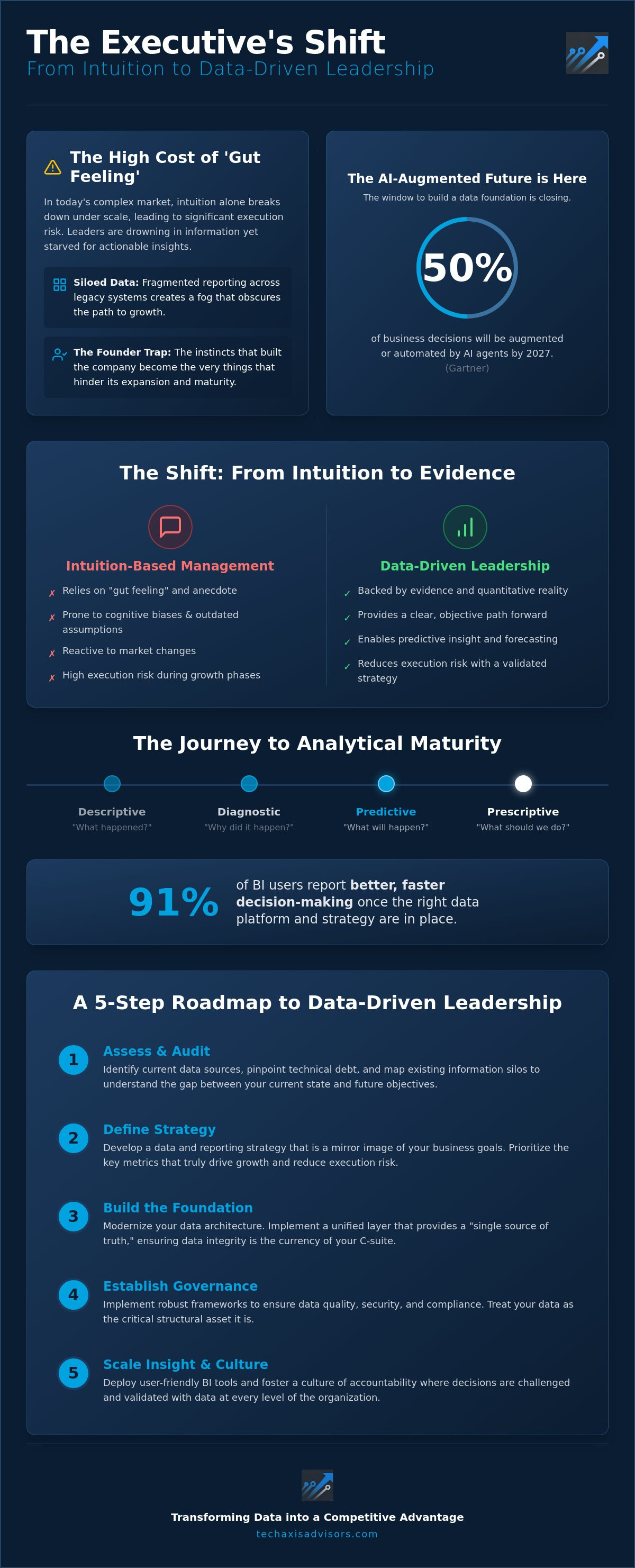
A 5-Step Roadmap for Implementing Data-Driven Leadership
Transitioning to a data-first culture requires more than a software purchase. It is a structural undertaking that demands a logical sequence of execution. To successfully implement data driven decision making for executives, you must move through a methodical process that aligns technical capabilities with your long-term business objectives. This roadmap ensures that your investment in data becomes a scalable asset rather than a sunk cost.
Step 1: Audit current data maturity. Identify exactly where reporting gaps exist. Pinpoint where your team is currently forced to use manual workarounds to reconcile conflicting data sets.
Step 2: Align data strategy with the 3-year business growth roadmap. Technology goals must be a mirror image of your commercial objectives. If you plan to acquire three firms by 2028, your data architecture must be ready to integrate those assets today.
Step 3: Establish a governance framework. Define clear standards for data accuracy and security. In financial services, these aren't just technical requirements; they're the foundation of your firm's reputation.
Step 4: Implement scalable architecture. Build for the future while avoiding vendor lock-in. Choose modular systems that allow you to swap components as the market evolves without rebuilding your entire foundation.
Step 5: Operationalize insights. Integrate evidence into your regular executive review cycles. Data should be the first item on the agenda, providing the objective context for every strategic discussion.
For firms looking to navigate this transition with precision, our AI Advisory & Automation Readiness assessment provides the necessary clarity to prioritize your initial moves and identify high-impact opportunities.
The AI Readiness Factor
Clean data is the absolute prerequisite for AI and automation. Many growth-stage companies rush into AI implementation only to discover their underlying data is too fragmented to be useful. Assessing your organizational readiness involves more than checking your tech stack. It requires evaluating whether your data is structured, accessible, and high-quality. Identifying high-impact AI use cases early allows you to build the specific data pipelines needed to support those initiatives. This proactive approach ensures that when you do deploy AI-driven decision support, it delivers immediate ROI.
Governance and Compliance Oversight
Investors and regulators are placing increased scrutiny on technology governance. As of April 2026, with the introduction of the SECURE Data Act and the GUARD Financial Data Act, national standards for data protection have become more stringent. Your reporting framework must protect the firm from the risks of AI-generated misinformation and ensure ethical data usage. Robust governance isn't a hurdle to growth; it's a prerequisite for it. Maintaining high standards for data integrity ensures that your firm remains attractive to investors and compliant with a rapidly evolving legal landscape.
Scaling Insight: The Role of Fractional Technology Leadership
Growth-stage organizations often reach a point where their technical debt begins to outpace their strategic vision. The internal team is capable of maintaining operations but lacks the specialized expertise required to architect a comprehensive data strategy. This is where the ceiling of intuition-based leadership becomes apparent. Without a senior architect to align technology with commercial objectives, data driven decision making for executives remains an aspiration rather than a core competency. You need a partner who understands the mechanics of scaling and the nuances of executive oversight.
A Fractional CTO serves as this strategic architect. They provide the necessary leadership bridge that a growing company might be missing, ensuring that every technical investment directly supports operational scalability. By translating high-level business goals into a structured technical roadmap, they enable the executive team to lead with evidence-based confidence. This role isn't about managing daily IT tickets. It's about building the structural integrity required to turn data into a high-impact strategic asset.
When to Bring in a Fractional CTO
Recognizing the need for external expertise is a mark of leadership maturity. Common signs include persistent reporting inaccuracies, a reliance on manual data reconciliation, or a technology roadmap that feels disconnected from the firm's growth targets. A fractional partner provides the senior-level oversight required to navigate these challenges without the overhead of a full-time executive hire. You gain access to veteran wisdom and a proven framework for scaling. To determine if your firm has reached this inflection point, review our guide on When Does a Growth Company Need a Fractional CTO?
Pragmatic Execution over Abstract Theory
TechAxis Advisors operates with a commitment to tangible results. We value execution over theory. Our focus is on improving your operational maturity and reducing execution risk through disciplined, executive-level technology advisory. We don't just offer advice; we partner with you to build a scalable operating foundation. This process begins with a clear-eyed evaluation of your current state. Taking the first step involves a comprehensive AI readiness and data strategy assessment to ensure your organization is prepared for the demands of the 2026 market. We provide the steady hand needed to move from organizational confusion to controlled, disciplined progress.
Mastering the Architecture of Informed Leadership
The transition from intuition-based leadership to a disciplined, data-first strategy is the defining challenge for growth-stage firms in 2026. You've seen how a robust data architecture serves as a structural foundation for scaling and how identifying technical debt is a prerequisite for operational maturity. Achieving excellence in data driven decision making for executives requires more than just modern software; it demands a leadership discipline that aligns technical execution with high-level business goals.
TechAxis Advisors provides the seasoned, fractional leadership necessary to bridge this gap. As a Certified Women-Owned Small Business (WOSB) with specialized expertise in wealth management and private equity, we deliver pragmatic, execution-focused advisory that moves the needle. We help you replace organizational anxiety with a sense of controlled, disciplined progress. This approach ensures that your technology roadmap is a mirror image of your commercial objectives.
Align your technology and data strategy with TechAxis Advisors to build a scalable operating foundation that reduces execution risk. Your path to operational mastery starts with a single, evidence-based decision. We're ready to help you architect that future.
Frequently Asked Questions
What is the first step for an executive to become more data-driven?
The first step is conducting a comprehensive audit of your current data maturity and identifying specific reporting gaps. You must pinpoint exactly where your team relies on manual workarounds or "gut feeling" to fill information voids. Once these gaps are visible, you can begin aligning your technical roadmap with your three-year business growth objectives. This process ensures that every subsequent technology investment serves a documented strategic need rather than a reactive technical request.
How much does it cost to implement a data-driven decision making framework?
Implementation costs vary based on organizational scale and existing technical debt. According to 2026 industry guides, entry-level BI tools like Power BI Pro start around $10 per user monthly, while comprehensive BI and big data consulting projects typically range between $10,000 and $49,999. The true investment includes the internal resources required to modernize legacy architecture and establish governance. A structured framework prevents the far higher expense of failed strategic pivots and operational bottlenecks later.
Can a growth-stage company be data-driven without a full-time CTO?
Yes, growth-stage firms frequently achieve high levels of analytical maturity by leveraging fractional technology leadership. A full-time CTO hire is often unnecessary and cost-prohibitive during early expansion phases. A fractional partner provides the senior-level architecture and governance required to implement data driven decision making for executives without the executive-level salary. This model allows you to scale strategic oversight and structural integrity in direct proportion to your organizational growth needs.
What are the most important KPIs for a CEO to track in 2026?
CEOs should prioritize "signal" metrics that reflect operational maturity and execution risk rather than vanity data. Key performance indicators in 2026 include predictive customer lifetime value, real-time operational burn rates, and AI-readiness scores across departments. You should also monitor data integrity levels to ensure the insights reaching your desk are accurate and compliant with new regulations. Tracking the right KPIs allows for quick, strategic interventions that prevent minor bottlenecks from becoming systemic failures.
How does data-driven decision making reduce technical execution risk?
Evidence-based forecasting reduces risk by replacing assumptions with verified performance data. When you have clear visibility into your technical architecture, you can identify and clear technical debt before it halts a major project. This discipline ensures that strategic pivots are based on current capacity rather than optimistic projections. High-quality data acts as an early warning system, allowing you to mitigate potential failures and resource constraints before they impact your bottom line.
Is AI necessary for data-driven decision making at the executive level?
AI is a powerful enhancer, but it's not the primary prerequisite for a data-first culture. The foundation of data driven decision making for executives is high-quality, structured data, not the complexity of the algorithms used to analyze it. While Gartner predicts that 50% of business decisions will be augmented by AI agents by 2027, these tools fail without a clean data strategy. Your initial focus should be on building a reliable reporting framework that provides a single version of the truth.
How do I know if my company’s data architecture is ready for scale?
Your architecture is ready for scale if it provides real-time, integrated insights without manual human intervention. If your team spends hours "cleaning" data before an executive meeting, your foundation is failing. A scalable system handles increased data volume and velocity without degrading performance or compromising security. It should also support the seamless integration of new data sources, such as those acquired during acquisitions, without requiring a total rebuild of your reporting layer.



Comments