

Fintech Integration for Wealth Managers: Aligning Systems and Teams
Fintech can improve a wealth manager’s client experience while making its operating model harder to coordinate. A sound fintech integration strategy for wealth managers connects platforms, data, workflows, and accountability to clear business and client outcomes, rather than treating integration as a software task alone.
Client expectations are shifting toward more connected, timely, and personalized financial experiences. Meeting them depends not only on the technology clients see, but also on how reliably information and work move across existing systems and teams. Wealth managers must balance better service with operational control and clear oversight of fintech partners.
This article explains how to assess whether new fintech fits established wealth management systems, guide internal and vendor change, and account for regulatory considerations in partnerships. It also explores where automation can reduce operational friction and how to tie integration decisions to measurable business needs. The result is a practical framework for aligning technology choices with the way the wealth business needs to operate.
Table of Contents
The Business Issue: Integrating Fintech with Traditional Systems
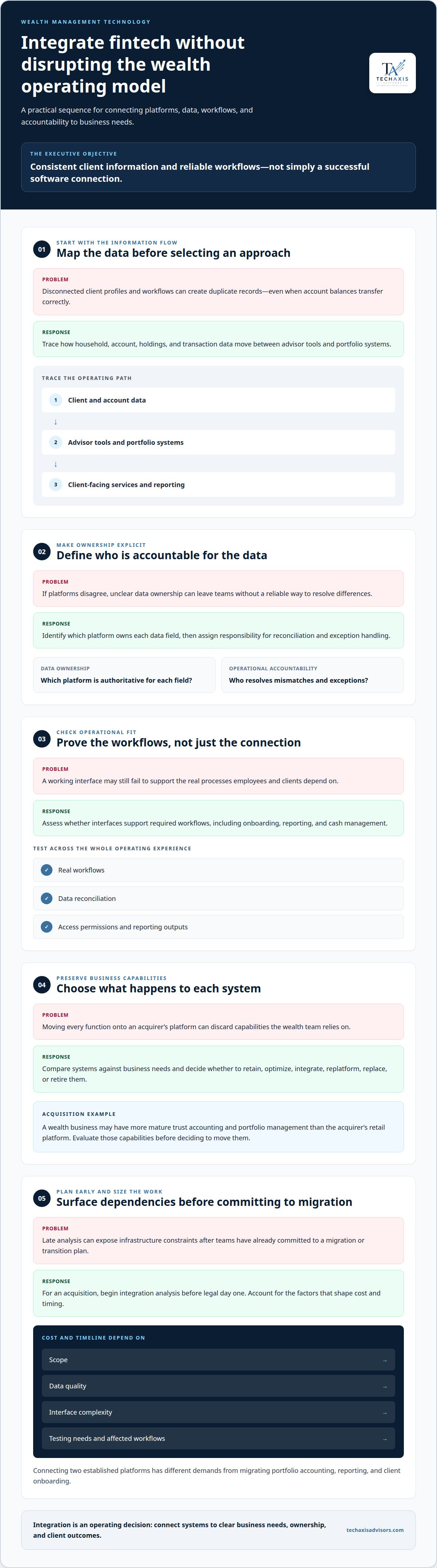
A fintech integration strategy for wealth managers must connect new capabilities to the systems that already support client accounts. A digital offering may improve onboarding or reporting, but disconnected client profiles and workflows can create duplicate records. The goal is consistent information across advisor tools, portfolio systems, and client-facing services.
For an acquisition, begin integration analysis before legal day one. Wealth businesses may use client profiles, technology, and workflows that differ from a bank’s core platform. Starting early helps leaders identify which functions can align, which should remain distinct, and where dependencies could disrupt service.
Consider a bank acquiring a wealth business with more mature trust accounting and portfolio management than the acquirer’s retail platform. Moving every function to the acquirer’s platform may discard capabilities the wealth team relies on. A structured comparison can show where to retain, optimize, integrate, replatform, replace, or retire systems.
Practical integration starts with mapping data and operational dependencies. An executive team can direct specialists to:
Trace how household, account, holdings, and transaction data move between advisor tools and portfolio systems.
Identify which platform owns each data field, then define reconciliation and exception-handling responsibilities.
Assess whether interfaces can support the required workflows, including onboarding, reporting, and cash management.
These steps expose infrastructure constraints before teams commit to a migration. For example, inconsistent household identifiers can fragment client insights even when account balances transfer correctly. Testing should cover real workflows, data reconciliation, access permissions, and reporting outputs, not just successful system connections.
Integration costs and timelines depend on scope, data quality, interface complexity, testing needs, and the number of affected workflows. Connecting two established platforms has different demands from migrating portfolio accounting, reporting, and client onboarding.
Regulatory review also belongs in the integration design. According to the Federal Register, Executive Order 14405 includes the financial activities listed in Appendix A to 12 CFR Part 242 in its definition of financial products and services. That definition provides context for review; it does not replace analysis of the specific partnership, services, and applicable requirements.
For U.S. wealth management firms, the wealth management firms we support page reflects the institutional context in which these decisions arise. Clear ownership for data, workflows, and exceptions helps executives connect platform decisions to operating accountability, rather than treating integration as a standalone technology project.
Software deployment is not a substitute for operational planning. Banks integrating wealth management technology after an M&A announcement should begin analysis before legal day one, guided by dedicated wealth management technology expertise. That expertise helps teams assess how wealth capabilities fit existing systems, ground decisions in business needs, and coordinate work across the functions involved. Bringing specialists in early gives leaders a clearer basis for managing the transition while preserving the systems and workflows that support wealth services. Integration is not simply a technology connection; the wealth business needs informed direction throughout the process.
A Decision Framework for Regulatory Review
A fintech partnership review should connect each service to its activities, data, and operating responsibilities. Start with a defined service map: distinguish, for example, a portfolio analytics tool from a service that opens accounts or facilitates transactions. This helps legal, compliance, technology, and business leaders assess the relationship using the same description.
Executive Order 14405 provides a federal reference point. According to the Federal Register, Executive Order 14405 includes activities set forth in paragraphs (A) through (G) of section 4(k)(4) of the Bank Holding Company Act of 1956 in its definition of fintech-related financial products and services, identified at 12 U.S.C. 1843(k)(4). The order also directs each U.S. federal financial regulator to review regulations, guidance, supervisory practices, and application processes for opportunities to facilitate fintech innovation within 90 days of the date of the order, and to take steps to encourage innovation within 180 days.
Those provisions do not replace a partnership-specific review. The analysis depends on what the fintech partner does, how the wealth manager uses the service, and which entities perform each activity. A partner supplying reporting software raises different questions from one involved in onboarding or moving client information. Map the service before drawing conclusions about its regulatory treatment.
For each proposed relationship, a cross-functional review can establish a clear record:
Describe the service, customer-facing functions, data exchanged, and financial activities involved.
Identify the entities responsible for client interactions, records, operational decisions, and issue escalation.
Compare the proposed arrangement with existing policies, agreements, supervisory guidance, and applicable processes.
Record open questions, decision owners, supporting evidence, and conditions for approval or ongoing oversight.
This process makes differences between fintech partners and traditional financial institutions visible. A startup may control its product roadmap, while the wealth manager remains responsible for coordinating client service and internal governance. Clear ownership prevents assumptions about who handles an access change, data correction, or service interruption.
How can an advisor help protect client data and manage cybersecurity risks during integration? An advisor can map data flows and access responsibilities, identify where sensitive information moves, and coordinate reviews of vendor controls, incident escalation, and testing. This creates a clearer record of risks and control ownership, but does not replace specialized security implementation.
Integration risks include inconsistent records, unclear accountability, service disruption, and a mismatch between contract terms and actual workflows. An advisor helps mitigate these risks by organizing evidence, surfacing dependencies, and assigning decision owners before launch. Capital and delivery commitments should follow that review, not stand in for it.
Options and Tradeoffs: Automation and WealthTech
WealthTech matters when it addresses a specific friction in the client or advisor journey. Digital onboarding, portfolio reporting, account aggregation, and transaction processing can reduce manual handoffs. Each capability also adds dependencies: data quality, system connections, supervision, and clear ownership of exceptions.
Automation is most useful when a process is repeatable and its inputs are controlled. For example, software can route account-opening information for review, flag missing fields, or consolidate data for advisor reporting. It should not obscure who approves an exception or how inaccurate information is corrected. Automating a weak workflow can simply make its errors move faster.
Industry-wide spending on internal automation and external software tools in wealth management was expected to reach $24 billion annually by 2023. The operational question is not how much technology to add. It is whether a capability reduces rework, improves the timeliness of insights, or gives advisors more capacity for client conversations without weakening oversight.
Which fintech solutions are most relevant to wealth management firms? Strong candidates address a defined need, such as digital onboarding, portfolio and performance reporting, account aggregation, or workflow automation. Relevance depends on fit with the firm’s clients, existing systems, and operating responsibilities.
WealthTech firms can also shape expectations through more accessible and responsive services. iCapital, Stash, and Public.com illustrate distinct areas of the sector, including private-market access, personal finance, and investing. Their presence does not mean every firm should adopt the same model. Established financial institutions need to assess whether a solution complements their advice proposition, client segments, and control environment.
Tradeoffs become clearer when leaders compare each capability with its operating consequences:
Automated data handling: Reduces repetitive entry, but depends on consistent records and exception review.
Digital client tools: Make information easier to access, but require alignment with advisor workflows and service expectations.
New investment capabilities: Expand the offering, but introduce additional operational and oversight demands.
Blockchain may suit particular transaction or recordkeeping models, but its presence alone is not a business case. Leaders should define the problem first, then assess whether the capability fits existing processes and delivers a practical operating benefit.
How can an advisor help measure ROI and adoption after integration? An advisor can establish baseline measures before launch, then track usage, process completion, exception rates, rework, and service outcomes against them. These measures connect adoption to operational value, rather than treating logins or licenses as proof of impact.
A disciplined decision weighs expected workflow benefits against integration effort, oversight requirements, and user adoption. This ties innovation to client and business outcomes while giving wealth managers a basis for expanding, adjusting, or retiring a capability.
Executive Considerations for Internal and Vendor Change
Technology change affects operating authority as well as software. In a bank acquisition, employees may move to a new company, receive new email addresses, and adopt different approval paths. Executives should assign accountable owners for each transition, including client communication, workflow decisions, and vendor coordination. Without clear ownership, teams may follow different processes during the same integration.
Change governance needs a documented decision trail. Record who approves platform changes, which criteria guide those decisions, and how affected vendors receive updates. For example, if a wealth institution retains one portfolio platform but integrates another reporting system, both vendors need clear information about responsibilities, dependencies, and transition milestones.
Vendor assessment should connect capabilities to the institution’s actual operating model. An advisor can evaluate functional fit, integration dependencies, data handling, service ownership, roadmap alignment, and the vendor’s role in supporting exceptions. The comparison should also consider effects on employees and clients, rather than treating product demonstrations as sufficient evidence.
A practical governance record can include:
Decision rights: Identify the executive sponsor, business owner, technology lead, and approval authority for each change.
Vendor responsibilities: Document who manages interfaces, data corrections, service issues, and transition communications.
Change impacts: Map affected roles, workflows, access, and client-facing processes before rollout.
Escalation paths: Define how unresolved dependencies or service interruptions reach accountable leaders.
These records help institutions distinguish a vendor’s contractual role from internal accountability. A global platform may provide a shared service, while a U.S. banking team remains responsible for coordinating local workflows and client support. The operating model should make responsibilities and handoffs visible.
How should an advisor assess fintech vendors and platforms for wealth managers? The advisor should compare proposed capabilities with business priorities, existing systems, data flows, contractual responsibilities, and operational dependencies. This creates an evidence-based view of fit, tradeoffs, and oversight requirements.
Communication also determines whether employees can put the new model into practice. Leaders should explain what changes, what remains stable, where decisions now sit, and how questions are escalated. For example, a new digital onboarding workflow needs aligned instructions for relationship managers, operations staff, and teams handling exceptions. Announcements alone do not establish readiness.
Executives can stage change around dependencies rather than vendor release dates. Sequence employee training, access changes, workflow transitions, and service handoffs so teams understand the operational impact before responsibilities shift. This gives leadership a clearer basis for resolving conflicts between legacy practices and the target model.
The TechAxis Perspective: Data and Reporting Strategy
TechAxis Advisors helps wealth management leaders align data, reporting, and technology decisions with operating priorities. Its Integration, Data & Reporting service is relevant when teams rely on inconsistent definitions, disconnected reports, or unclear information ownership. The work focuses on what leaders need to see, how the underlying data supports it, and which systems should provide it.
Reporting gaps often point to a broader operating issue. Advisors and executives, for example, may use different definitions of household, assets, or performance. A dashboard cannot resolve that disagreement on its own. Leaders need consistent data definitions, accountable owners, and a reporting model that reflects how the firm makes decisions. That foundation can guide whether to retain, optimize, integrate, replatform, replace, or retire systems.
TechAxis can structure an executive decision-support engagement around the decisions at stake. An Executive Technology Assessment can produce evidence-based findings and a prioritized roadmap. The assessment connects business objectives to platform dependencies, reporting needs, delivery risks, and ownership. It helps leadership distinguish immediate operating needs from longer-term technology choices without assuming replacement is the answer.
The right support depends on the source of the problem:
Data & Reporting Strategy: Aligns reporting priorities, data definitions, and decision needs across teams.
Fractional CTO Services: Adds technology leadership when executives need accountable oversight of architecture, priorities, or delivery coordination.
Vendor & Platform Management: Supports vendor oversight when dependencies, responsibilities, or platform decisions need clearer governance.
AI Advisory & Automation Readiness: Helps assess whether automation fits the process, data, and business objective.
These offerings are most useful when leadership needs an independent view of tradeoffs or a bridge between business priorities and technical execution. TechAxis provides advisory leadership, governance, and vendor oversight. Custom software development and implementation services are available through a white-label partnership. The engagement can support delivery planning and qualified delivery partners, rather than assuming TechAxis directly performs every implementation.
Before work begins, executives can clarify the decisions they need to make, the business owners involved, and the reporting or platform questions still unresolved. Relevant materials may include current reports, system maps, vendor arrangements, and strategic priorities. This context keeps the analysis focused on consequential choices, not a generic technology inventory.
For leadership teams weighing a fintech integration, Integration, Data & Reporting can provide a practical starting point. It connects integration choices to the information executives use to oversee client service, operations, and performance.
Start a confidential executive conversation with TechAxis Advisors about the decisions your integration requires.
Frequently Asked Questions
How Are Client Expectations Evolving Due to Fintech in Wealth Management?
Clients increasingly expect a coherent experience across digital and human interactions. For example, a client who reviews a planning discussion online should encounter consistent priorities when speaking with an advisor later. Wealth managers can respond by aligning service standards across channels and clarifying which interactions require personal guidance. This is a client-experience design decision, not simply a matter of adding another app or portal.
How will FinTech impact the traditional Wealth Management space?
Fintech can change how firms segment clients and structure service models. A firm might use digital services for clients who need straightforward account access while preserving advisor-led engagement for complex planning needs. That choice affects the firm’s value proposition, staffing model, and client experience. Leaders should decide which parts of their offering rely on personal advice and where technology can provide a distinct, consistent service.
What is a fintech integration strategy for wealth managers?
A fintech integration strategy for wealth managers defines how new capabilities fit the firm’s operating model and technology estate. A useful distinction is between systems that create or maintain authoritative records and tools that present information or support interactions. Defining that boundary helps determine where a new capability belongs, which existing functions it complements, and what decision rights apply when records conflict.
What are the main wealth management integration architectures and APIs?
Common patterns include direct connections between systems, a shared integration layer, and event-based exchanges. Direct connections can suit a limited interface; an integration layer can centralize transformations across several applications; event-based designs distribute updates when defined events occur. APIs provide structured ways for systems to exchange information. Architecture choices should account for change frequency, data transformation needs, failure handling, and the effort required to maintain connections.
How can an advisor help wealth managers integrate fintech with legacy portfolio and CRM systems?
An advisor can help define interface specifications and coordinate release dependencies between legacy platforms and new services. For example, an integration plan can identify which system changes must be deployed together and which can be released independently. This reduces the chance that a vendor update unexpectedly disrupts a connected workflow. An advisor can also establish change-control decisions and cutover criteria for each release.
What U.S. regulatory requirements apply to wealth management fintech integrations?
There is no single regulatory checklist that applies identically to every wealth management integration. The relevant review depends on the firm’s status, the service provided, the parties’ roles, and how the arrangement affects client interactions and records. A decision record should explain the service classification, applicable requirements identified by compliance and counsel, and how the agreement and operating model address them.
What steps should an advisor follow to help wealth managers plan and implement a fintech integration?
An advisor can begin by establishing a decision charter: the business objective, scope boundaries, executive sponsor, and criteria for proceeding. Next, the advisor helps leadership compare options and agree on approval gates, cutover conditions, and a fallback approach if essential functions fail. These decisions give delivery teams clear authority and a shared definition of readiness, while keeping expansion or further investment subject to executive review.
What are typical fintech integration costs and timelines for wealth managers?
Costs and timelines depend on scope, data quality, interface complexity, testing needs, and the number of affected workflows. Connecting two established platforms differs from migrating portfolio accounting, reporting, and onboarding.



Comments