

How to Present a Tech Budget and Explain Costs to the Board
Presenting a tech budget to the board means comparing proposed spending with prior-year actuals and current-year projections, then tying each major cost to a business priority, expected outcome, and risk. Show the figures side by side, explain significant changes in plain language, and identify the decisions the board must make. A multi-year view helps distinguish ongoing commitments from one-time investments.
That comparison matters, but directors also need to understand what could happen if an investment is delayed, reduced, or approved without adequate oversight. A list of costs without dependencies, tradeoffs, and exposure leaves the central decision unanswered.
This guide explains how to build a clear comparison, translate financial concepts, present a multi-year view, and tailor materials to directors’ needs. It also shows how to surface risks and frame decisions so discussion stays focused on strategic choices, not a crowded spreadsheet.
Table of Contents
Comparing the proposed budget with the prior-year budget
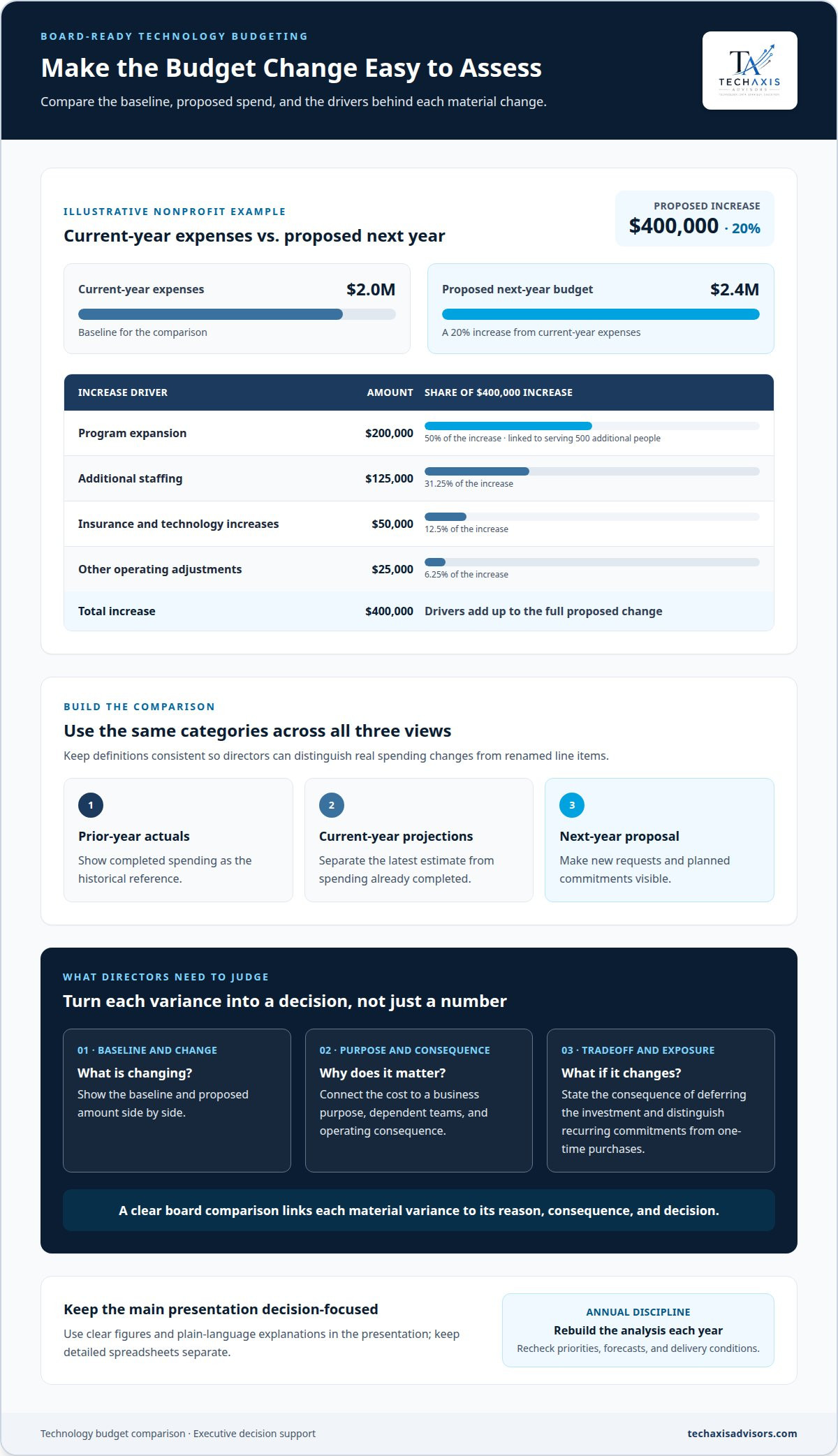
Build a three-column comparison before explaining any increase. Place prior-year actuals, current-year projections, and next year’s proposed budget side by side. This separates completed spending from estimates and new requests. Use the same categories across all three columns so shifts in staffing, infrastructure, or support costs are easy to spot. Consistent definitions also help show whether a change reflects actual spending movement rather than a renamed line item.
Calculate the total change, then show its components. An illustrative nonprofit budget moves from $2 million in current-year expenses to a proposed $2.4 million next year, a 20% increase. The $400,000 increase is easier to assess when tied to specific drivers. In that example, $200,000 supports program expansion, $125,000 covers additional staffing, $50,000 reflects insurance and technology increases, and $25,000 covers other operating adjustments. These components explain the change instead of leaving the board with one headline figure.
Connect each major technology variance to an operating consequence. If a line rises because of a platform expansion, describe what the organization plans to do differently and which teams depend on it. The nonprofit example links program expansion to serving 500 additional people. A technology presentation can use the same logic: identify the capability being funded, its business purpose, and the result leaders will monitor. Separate recurring commitments from one-time purchases, since they create different future obligations.
Use peer comparisons to add context, not to justify a request. Compare organizations using measures relevant to the decision, such as service levels, operating capacity, or technology outcomes. Include peers that perform better in relevant areas, then explain what the comparison reveals about your organization’s position. For wealth management and financial services firms, compare similar operating models before drawing conclusions. A useful comparison identifies a gap, its business impact, and the proposed response.
Rebuild the analysis each year and state the assumptions behind it. Don’t reuse last year’s presentation with only updated figures; test whether priorities, forecasts, and delivery conditions have changed. For each material variance, show the baseline, the proposed change, the reason, and the consequence of deferring it. This creates a clear decision trail for board members. A wealth management and financial services audience can then assess technology spending against its own operating priorities, rather than treating peer figures as a target.
Explaining financial concepts in plain language
Explain each financial term in business language, then show how it affects the board’s decision. Use these steps to make costs, value, and budget outcomes easier to understand.
Translate Financial ConceptsDefine each financial term the first time it appears and connect it to a business example. For instance, explain that a forecast is an estimate based on current assumptions, not a final result. Replace unexplained abbreviations with familiar language, and review every slide for terms a nontechnical director might interpret differently. Plain descriptions help directors focus on the decision instead of decoding finance or technology terminology.
Compare Capital and Operating ExpensesSeparate capital expenses from operating expenses and explain their different budget effects. Capital expenses generally relate to acquiring or developing an asset; operating expenses cover ongoing activities, such as recurring service or support. Compare each category over the same planning period, and clarify whether a proposed item is an initial investment or a continuing commitment. To compare them, show the categories separately, state their purpose, and identify which costs continue.
Calculate ROI and Business ValueCalculate return on investment by comparing quantified benefits with total costs over the same evaluation period. A common formula is net benefits divided by total costs, expressed as a percentage. To calculate ROI and business value for technology investments, define measurable benefits and costs first, then apply the formula consistently. Include operational value, such as reduced manual effort, only when the organization can explain how it will measure the change.
Explain a planned surplus or deficit as a choice with consequences. In an illustrative nonprofit budget, revenue of $1,500,000 and expenses of $1,425,000 produce a planned surplus of $75,000. State whether that surplus supports reserves, future priorities, or another purpose. A different nonprofit example plans a $100,000 deficit to complete a major technology investment approved within its strategic plan. Explain the reason, funding source, and expected effect in plain language.
Show the assumptions that connect forecast figures to board decisions. An illustrative reserve projection adds $50,000 from operations, which helps explain how operating performance affects available reserves. Distinguish forecast assumptions from committed spending, and identify the factors that could change the outcome. A concise explanation might state that lower adoption delays expected savings, while unchanged costs leave the planned investment’s value unproven. For support aligning financial explanations with governance decisions, discuss technology budget governance.
Structuring a multi-year financial presentation
Build the presentation around the decisions directors must make, not a sequence of technology projects. Show costs, assumptions, alternatives, and risks across the relevant planning periods.
Organize the Board PresentationOpen with the decision requested, then present the financial outlook and supporting rationale. Structure the presentation with a clear opening, a substantive middle, and a focused conclusion. Use the opening to frame the business priority, the middle to explain forecasts and tradeoffs, and the conclusion to state approvals and next steps. Include a concise recommendation, assumptions, and supporting schedules in the board packet. Follow the organization’s approval process.
Categorize and Forecast Technology SpendingGroup spending by business purpose and cost behavior, then forecast each category across the planning horizon. Separate recurring services, internal resources, one-time initiatives, and risk-related investments. State the assumption behind each forecast, such as a contract renewal, planned implementation, or expected usage. Show which costs continue after launch and which depend on a future decision. Avoid combining unrelated items in a single technology line.
Present Budget ScenariosPresent baseline, recommended, and reduced options using the same categories and assumptions. The baseline maintains current commitments; the recommended option funds stated priorities; the reduced option shows what would be delayed, narrowed, or removed. Explain the operating consequence of each choice, not just its total cost. Directors can then compare tradeoffs consistently and see which capabilities or outcomes change under each scenario.
Present Security and Compliance CostsGroup cybersecurity and compliance spending by control purpose, business exposure, and timing. Distinguish ongoing costs from planned investments, and explain what each item enables, such as access oversight, monitoring, or documented processes. Identify the risk addressed and the remaining exposure if funding changes. Do not present security spending as a guarantee against incidents. Use clear language instead of unexplained control names or regulatory abbreviations.
Close with a decision record that connects the board’s choice to execution. State the recommended scenario, the approval requested, and the assumptions requiring management oversight. Identify dependencies, accountable executives, and measures for tracking progress. If directors request a change, record its budget and operating implications before revising the plan. This creates a consistent reference for future reviews and makes differences between approved and forecast spending visible.
For a school district, place prior-year actuals, current-year projected results, and the next year's budget side by side in a multi-year financial projection. This gives the presentation a consistent view of how the outlook changes across periods. Prepare new analysis each year rather than carrying forward the previous year's presentation with only updated data. Explain financial concepts in plain language, and avoid unexplained jargon and abbreviations, so directors can follow the assumptions and tradeoffs behind the figures.
Adapting presentation materials to audience needs
Align the technology budget with business strategy by mapping each requested investment to a board priority and an operating outcome. For example, connect a reporting investment to faster management decisions, then explain how leaders will assess progress.
Start with the board’s current priorities and map each budget item to one. If growth is a priority, show how a proposed capacity investment supports expansion. If operational resilience matters, connect relevant spending to continuity, oversight, or reduced dependence on manual processes. Remove items without a clear strategic connection from the main narrative, or explain why they remain necessary.Use the same priority language as the organization’s strategy materials. This helps directors trace a line from stated objectives to proposed spending. For example, describe a data initiative by the decision it supports, not only by its technical components.
Lead with the information directors need to decide, not every available detail. Slides crowded with vendor names, system components, and line-item estimates can obscure the business case. Present the requested decision, strategic rationale, key tradeoffs, and material risks instead. Keep supporting detail available for follow-up questions, so directors can review the evidence without losing sight of the main argument.Use a simple chart to show spending trends or the relationship between costs and priorities, with a brief explanation alongside it. For example, clarify whether a proposed investment supports a new capability or maintains an existing service.
Tailor the emphasis to directors’ roles and expertise. A CFO may focus on recurring commitments, forecast assumptions, and financial exposure. A director with operations experience may prioritize service continuity and staff impact. Keep the recommendation consistent while adjusting which evidence appears first. Never change assumptions or conclusions between presentation versions.Keep detailed spreadsheets separate from the slide deck. Provide supporting schedules to stakeholders who need to examine individual assumptions. This avoids overwhelming the main presentation while preserving access to detailed analysis.
Use plain-language labels and define technical terms before they affect a decision. Replace a phrase like “data integration layer” with a description of the business function it enables. If a technical term is essential, explain its relevance immediately. Directors should understand the proposed outcome without interpreting architecture diagrams or unexplained abbreviations.Pair each chart with a clear takeaway. For example, state whether the forecast assumes an existing platform remains in use. Explain how changing that assumption affects the recommendation rather than leaving directors to infer the impact.
Prepare for the questions directors are likely to ask. Explain the consequences of delaying an investment, identify the owner responsible for delivery, and state how management will track progress. If a director asks about an uncertain forecast, answer directly and provide supporting analysis as needed. Keep the recorded decision and subsequent materials consistent.Use feedback from previous board discussions to improve the next presentation. If directors found it difficult to distinguish ongoing costs from project spending, revise the labels and explanation. Better materials make strategy, budget choices, and management accountability easier to assess.
Board roles and decisions
Define the board’s decision before presenting technical detail. State whether directors are approving funding, setting risk tolerance, or endorsing a strategic priority. For example, distinguish approval of a platform investment from management’s responsibility to select vendors and direct delivery. Presenting a tech budget to the board is clearer when the requested decision is explicit. Directors can then focus on oversight, affordability, and business alignment.Clarify the boundary between governance and execution. The board considers strategic fit and material exposure; executives manage implementation and operational coordination. For a customer-data initiative, directors might approve the investment while management chooses the design and delivery approach.
Describe the consequences of delay, reduced scope, or insufficient oversight. If a system depends on aging infrastructure, explain which operations rely on it and what constraints a delay could create. Identify the dependency, potential business impact, and management response without presenting risk as a prediction. This gives directors enough context to assess the plan without requiring them to evaluate technical specifications.Include shortcomings as well as positive outcomes. If an earlier initiative missed its adoption objective, explain what management learned and how that changed the current proposal. Connect the lesson to revised assumptions, ownership, and monitoring.
Frame alternatives in terms of decisions. For each option, identify the capability preserved, deferred, or added, and explain the operational effect. If a reduced plan postpones integration work, describe which teams would continue manual processes. Do not imply that a lower-cost option delivers the same outcome when its scope differs.Explain why management recommends one path and what evidence supports it. Identify the conditions that would prompt leaders to revisit the recommendation, such as a changed business priority or a delivery dependency.
Align executive presenters before the meeting. The CEO, CFO, and technology leader should use consistent assumptions, explain the same recommendation, and state the same approval request. For example, agree on how to explain a forecast change before distributing board materials. Assign an executive owner to each anticipated question so directors receive coordinated answers.Answer questions honestly during the discussion. If a forecast assumption needs validation, state what information is required and which executive will follow up. Record the question and next action in the meeting notes.
Document the board’s decision and its boundaries. Record the approved direction, any conditions, and the decisions that remain with management. Assign an accountable executive and a reporting measure to each approved priority. A disciplined approach to presenting a tech budget to the board carries into later reviews: compare progress with the decision record, note changed assumptions, and surface emerging risks.This record gives directors a clear basis for oversight while preserving management’s responsibility for execution. Use it to track whether approved priorities remain aligned with organizational needs.
TechAxis Advisors: Fractional CTO Services
TechAxis Advisors’ Fractional CTO Leadership can help executives connect technology priorities, budget assumptions, and board decisions. Consider this support when leadership needs senior technology guidance to assess proposed investments, clarify tradeoffs, or strengthen oversight of execution. The focus is executive decision support and practical leadership, with recommendations tied to business priorities and management accountability.
For budgets involving AI or data and reporting, advisory can help leaders clarify readiness and information requirements. Engagements are scoped around your priorities, with direct access to executive-level advisory - no handoffs.
Schedule an Advisory Conversation with TechAxis Advisors.
Carry board decisions into disciplined execution
Board approval is the start of budget governance, not the end. Keep approved priorities connected to management actions, ownership, and the assumptions behind the plan. This supports more deliberate decisions when business needs or delivery conditions change.
The discipline of presenting a tech budget to the board also strengthens ongoing oversight. Treat each approval as a management commitment to track progress and surface material changes, not simply permission to spend.
When leadership needs help connecting technology choices with business priorities, TechAxis Advisors offers Fractional CTO Leadership, AI Strategy & Advisor, and Integration, Data & Reporting. This executive-level advisory can clarify the decisions, information, and leadership needed to move from a board-approved direction into execution.
With clear ownership and ongoing attention, board decisions can guide focused progress beyond the budget meeting.
Frequently Asked Questions
Don’t Forget the Big Question: What Could Go Wrong?
Delivery can stall if a critical vendor, data source, or internal owner is unavailable. Identify the dependency, its operational consequence, and who will escalate a delay. This gives directors a practical view of exposure without treating a risk as certain.
How Much Is Enough?
Adequate funding supports defined business outcomes, required service levels, and accepted risk. Check whether the plan accounts for adoption, ongoing support, and internal capacity, not just initial acquisition. Unfunded responsibilities can weaken the business case.
What should a board-level technology budget presentation include?
Include the requested decision, business rationale, accountable executive, key dependencies, and oversight measures. For a customer-facing change, explain how management will monitor service continuity during the transition. Put technical specifications in supporting materials unless they affect the board’s decision.
What benchmarks are available for IT spending as a percentage of revenue?
No single percentage applies to every organization. Compare your own spending trend and use peer data only when operating models and included cost categories align. Treat the ratio as a prompt for investigation, not proof that spending is sufficient or excessive.
How do you explain technology budget variances and cost increases?
Identify the driver, such as a change in scope, usage, timing, or estimates. Explain whether it is temporary and which outcome it affects. For example, distinguish expanded employee access from a supplier price change so directors can assess the underlying cause.
What technology budget risks and assumptions should boards review?
Review assumptions about adoption, integration, data quality, vendor delivery, and internal capacity. Ask what evidence supports each assumption, who monitors it, and what triggers escalation. For example, identify the contingency if a required integration is delayed.



Comments