

Improving EBITDA Through Technology and Process Improvements
Yes. Improving EBITDA through technology optimization can strengthen operating margins and expand a company’s exit options when technology decisions address real costs, capacity constraints, or process friction. The value comes from measurable operational improvement, not adopting technology for its own sake.
For executives and investors, the challenge is connecting an initiative to financial results. Automation may reduce manual work, while better data and process design can improve productivity and decision-making. Projected savings matter only when owners track them and verify their effect on operating results.
This article explains how technology and process improvements can contribute to EBITDA growth, where AI may fit, and how to prioritize initiatives against costs, dependencies, and expected impact. It also covers accountable savings tracking and how credible evidence of operational performance can support flexibility in a future transaction.
Table of Contents
The Business Case for Technology-Driven EBITDA Improvement
Technology affects EBITDA when it changes operating costs, staff capacity, or the output a business can deliver. Process redesign and automation can reveal efficiency opportunities, but the financial impact depends on what changes in day-to-day operations. Improving EBITDA through technology optimization means linking specific operational changes to measurable financial results.
Automation and Cost Reduction
Technology-driven automation uses software or connected systems to reduce manual work in repeatable processes. For example, automating routine data entry can reduce handling and errors, while consolidating overlapping software can lower recurring spend. Executives should weigh these benefits against implementation, support, and transition requirements. Improving EBITDA through technology optimization means assessing the net operating effect, not treating automation itself as a saving.
Diagnosing EBITDA and Margin Drivers
A sound diagnosis connects financial results to the operational activity behind them. The team examines available EBITDA and margin trends, then identifies where process delays, duplicate systems, vendor spend, or manual work affect cost and output. For example, if reporting requires repeated reconciliation across platforms, the analysis maps the workflow and technology dependencies before recommending a change. This helps distinguish recurring operating improvements from accounting adjustments or temporary effects.
Labor Productivity Through Automation and AI
Automation and AI can improve labor productivity by reducing time spent on repetitive tasks and helping teams use information effectively. Workflow automation, for example, can route routine requests, while analytical tools can help managers identify bottlenecks. Productivity gains contribute to EBITDA when released capacity reduces costs or supports more output without a proportional increase in labor. Measures should connect time saved to actual operating results.
Technology priorities vary by industry and company size because workflows, constraints, and resources differ. A financial services firm may focus on reporting and manual client operations, while a manufacturer may prioritize equipment downtime. A smaller company may address one constrained workflow, while a larger portfolio may coordinate changes across business units.
Cutting technology costs too aggressively can remove systems or support that protect productivity, service continuity, or control. Before reducing a contract or retiring a platform, assess dependencies, business impact, and transition effort. A lower invoice is not a durable saving if the change disrupts service or shifts costs elsewhere.
For exit planning, disciplined technology improvements can make operating performance easier to explain. A consistent record of reduced manual effort, rationalized vendors, and measured process outcomes gives prospective buyers clearer evidence of how the business operates. The goal is a durable operating structure that supports margins and strategic options, not technology adoption for its own sake.
A Decision Framework for Prioritizing Initiatives
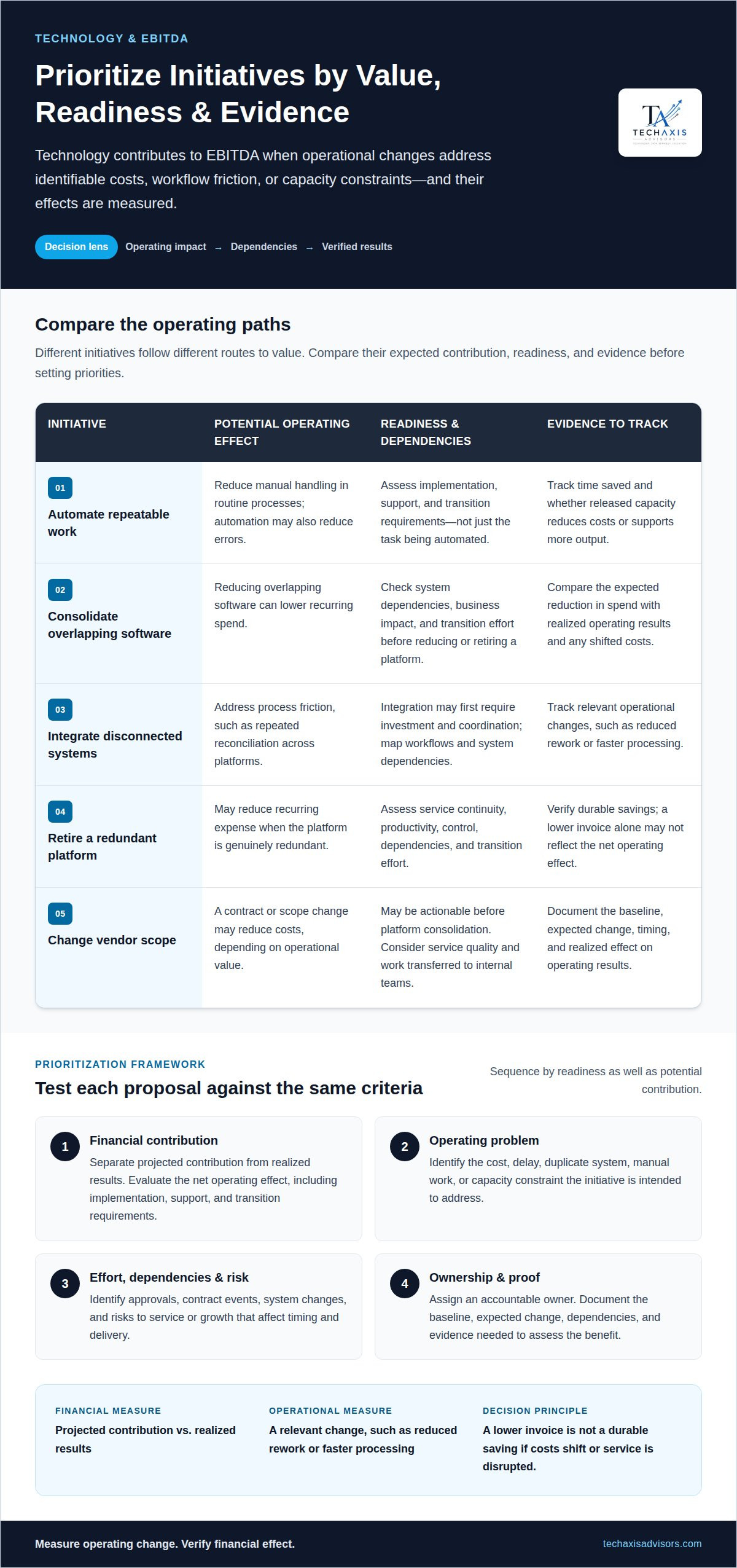
Prioritization turns a broad technology agenda into accountable work. A sound framework connects each proposal to its expected EBITDA effect, strategic relevance, owner, and evidence needed to assess progress. This directs attention toward initiatives with a credible operating rationale rather than projects chosen for visibility or vendor preference.
Begin by comparing opportunities against consistent criteria. Assess potential financial contribution, the operating problem addressed, implementation effort, dependencies, and risk to service or growth. Retiring a redundant platform, for example, may reduce recurring expense, while integrating disconnected systems may first require investment and coordination. These initiatives follow different paths to value, so keep their timing and assumptions distinct.
Each initiative needs an accountable owner with authority to coordinate the relevant teams. A CFO or operating partner can sponsor the overall effort, while functional leaders own delivery in their areas. The owner should document the baseline, expected change, key dependencies, and evidence that will demonstrate the benefit. This makes improving EBITDA through technology optimization a managed operating agenda, not just a collection of forecasts.
Financial measure: Separate projected contribution from realized results.
Operational measure: Track a relevant change, such as reduced rework or faster processing.
Dependencies: Identify approvals, contract events, and system changes that affect timing.
Sequence initiatives by readiness as well as potential. Some work can proceed with existing authority and information; other changes depend on a renewal, migration, integration, or policy decision. A vendor scope change, for example, may be actionable before a platform consolidation. Treating both as equally ready can distort forecasts and leave teams accountable for outcomes they cannot yet influence.
Supplier and vendor decisions require a view of operational value, not just price. A contract reduction may affect service quality or create new work for internal teams. Executive decision support can organize the evidence, test assumptions, and compare alternatives for management and investors. A structured advisory process can clarify decision rights and reveal where a recommendation depends on unresolved business choices.
Governance connects assumptions to actual outcomes. The roadmap should distinguish committed work, active delivery, and benefits already demonstrated. Board reporting can show each initiative’s financial estimate, status, timing, and evidence in the same format as other value-creation work. If a contract change has not altered invoices, or a redundant service remains active, record its status accurately instead of counting anticipated savings as realized.
Consistent reporting also strengthens investor discussions. Leadership can explain why an initiative was selected, what conditions remain, and how operating evidence supports its financial estimate. When assumptions change, document why and revise the forecast transparently. This gives decision-makers a clear basis for continuing, adjusting, or stopping the work.
Technology and Process Options: Benefits and Tradeoffs
Technology and process choices affect EBITDA through lower operating expense, greater capacity, or improved output. For a private equity portfolio, the right option depends on each organization’s operating model, existing systems, and ability to measure benefits. Evaluate cloud cost optimization against the company’s own spending baseline, workload requirements, and delivery plan, not an assumed universal savings percentage.
Modernization does not automatically mean replacement. A disciplined analysis compares whether to retain, optimize, integrate, replatform, replace, or retire a system. Optimizing an existing cloud environment, for example, may address underused capacity, while integrating platforms may reduce duplicate data handling. Replacement also creates transition work, so weigh the expected operating benefit against investment and disruption.
Cloud cost optimization begins by examining which workloads consume resources and whether that usage supports business needs. Use the organization’s own baseline: compare current cloud expense with usage, service requirements, and the cost of proposed changes. Separate savings already reflected in invoices from estimates dependent on architectural changes, contract terms, or future adoption. This keeps the analysis grounded in the company’s actual operating profile.
Usage: Identify workloads whose capacity exceeds observed demand.
Architecture: Examine design choices that may drive unnecessary consumption.
Business fit: Preserve performance and resilience requirements while evaluating savings.
Measurement: Compare actual expense with the agreed baseline after changes take effect.
Process improvements can complement cloud changes. Connecting data flows between finance and operations, for example, may reduce reconciliation work and improve reporting. Automating a repeatable workflow can also reduce manual handling. The relevant measure is whether the process uses fewer resources or supports more output, not whether a new tool has been deployed.
Initiatives have different paths to realization. Removing unused software may affect recurring expense once the subscription or service ends. A major implementation may require migration, testing, user adoption, and changes to operating practices before its full effect appears. A contract adjustment and a platform migration therefore need separate assumptions, milestones, and evidence requirements.
For valuation discussions, distinguish ongoing operating improvements from temporary reductions or implementation effects. A private equity investor evaluating a portfolio company needs evidence that savings persist without impairing service or growth capacity. Lower cloud consumption is more relevant to value creation when it reflects sustained efficiency rather than deferred maintenance or constrained operations.
Compare options using consistent criteria: expected EBITDA effect, implementation requirements, operating risk, and evidence of realized results. This makes tradeoffs visible and helps executives distinguish a documented efficiency opportunity from a projection based on untested assumptions.
Executive Considerations for AI and Operational Efficiency
AI and machine learning can help identify operational improvements, but the financial effect depends on process changes and adoption. Executives should distinguish immediate operating gains from longer-term effects on margin and profitability.
Operational Process Improvement
AI can support operational efficiency by analyzing information to expose bottlenecks, redundancies, and patterns that manual review may miss. Data analysis, for example, can help streamline supply-chain operations, while predictive maintenance can help anticipate equipment failures and avoid downtime. The executive question is whether the insight changes a critical process, not simply whether a model produces an output.
Short- and Long-Term Gains
Short-term gains can come from simplifying a workflow or addressing an identifiable source of delay. Longer-term improvement may depend on integrating data, redesigning responsibilities, and embedding new processes across the organization. A maintenance prediction, for example, is useful only if teams can act on it. Separate early operational indicators from later financial effects to avoid treating projected benefits as realized EBITDA.
Profit Margins and Operating Profitability
Operational efficiency affects margin when an organization produces more with its existing resources or reduces recurring operating costs. Revenue per employee can help indicate whether process, technology, or organizational changes improve productive capacity. Read it alongside service quality and revenue trends: a higher ratio alone does not establish stronger profitability if customer outcomes or growth weaken.
Machine Efficiency and Operational KPIs
Machine efficiency measures how effectively equipment supports production against operating expectations. Useful KPIs include throughput, downtime, defect rates, and equipment availability. Aggregated downtime data can help diagnose lost capacity. Pair machine metrics with production volume and maintenance records to identify recurring causes rather than treating every interruption alike.
For a production team, sequence matters: establish a baseline, identify the constraint, and test whether process or equipment changes address it. A brief interruption may seem immaterial during an individual shift, yet repeated stoppages can reduce output. Tracking downtime by cause helps distinguish maintenance issues from scheduling or handoff problems.
Executives should also define decision thresholds before expanding an AI use case. A pilot that improves prediction accuracy but does not change maintenance timing or production availability has limited operating value. The relevant evidence links model output to action, changed KPIs, and sustained results across the affected process.
For service organizations, equivalent measures may include turnaround time, rework, and workload per team. Comparing these indicators before and after process changes clarifies whether automation improves operating capacity. In services and production alike, margin impact follows sustained operating improvements, not AI deployment alone.
TechAxis Advisors: Technology Governance & Compliance
TechAxis Advisors helps executive teams connect technology decisions with operating priorities, governance, and measurable business outcomes. When projected savings lack clear ownership, AI proposals lack an operating case, or vendor decisions carry strategic consequences, structured decision support can clarify the next steps.
Technology Governance & Compliance can establish decision rights, oversight, and accountability for technology initiatives. This matters when a cost-reduction proposal affects systems that support critical business processes. Consolidating platforms, for example, requires leaders to understand dependencies and operational impact, and to define how they will confirm redundant services are retired.
A structured Executive Intelligence Assessment is an executive decision-support engagement that provides evidence-based findings and a prioritized roadmap. It can help executives compare options such as retaining, optimizing, integrating, replatforming, replacing, or retiring technology. Decisions should reflect business needs, operating constraints, and the evidence behind expected benefits, rather than assume a new platform is automatically the answer.
For AI and automation decisions, AI Strategy & Advisor can help assess whether a use case is grounded in a workable process and relevant data. A practical evaluation connects the proposed application to an operating problem, identifies dependencies, and defines how the organization will assess results. This supports a disciplined investment discussion with management, investors, and vendors.
Fractional CTO Leadership provides executive-level technology guidance when an organization needs stronger oversight of its roadmap, vendors, or delivery priorities. This can be useful when decisions span business units, internal ownership is unclear, or leadership needs to connect strategic intent with execution. Vendor oversight keeps attention on commitments, dependencies, and the business purpose of each platform.
When a roadmap requires software development or implementation, TechAxis Advisors can support those services through a white-label partnership. The engagement can align delivery priorities with executive decisions and governance. The distinction matters: advisory leadership and oversight guide execution, while qualified delivery partners carry out implementation work.
The right starting point depends on the decision facing leadership. A company evaluating automation may need readiness and process analysis; a business facing fragmented oversight may need governance and technology leadership. A portfolio-wide initiative may require consistent decision criteria and reporting across organizations. In every case, the work should clarify priorities, owners, dependencies, and evidence for tracking progress.
For executives seeking a disciplined view of technology priorities and their operating implications, start a confidential executive conversation with TechAxis Advisors.
Frequently Asked Questions
How much EBITDA improvement is realistic in the first year?
A disciplined first-year improvement plan may target 10% to 20%, but that range is a planning benchmark, not a company-specific forecast. The achievable result depends on the starting EBITDA baseline, the initiatives selected, and how quickly operational changes take effect. A business with a validated cost opportunity and clear ownership can set a more credible target than one relying on untested savings estimates.
What are the most effective steps a professional team takes in an EBITDA improvement plan to improve margins?
A sound process first reconciles the baseline with finance, separating recurring operating performance from one-time items. It then tests potential margin levers against underlying data, such as service costs by customer segment or technology expense by business unit. Next, it models dependencies and assigns owners. As changes take effect, finance reviews the calculations, helping leadership distinguish realized improvement from timing shifts or accounting adjustments.
What Is An EBITDA Improvement Plan, And Why Is It Critical For Increasing Profitability?
An EBITDA improvement plan is a governed portfolio of actions intended to strengthen operating earnings through revenue, cost, or productivity changes. It matters because separate departmental efforts can conflict or count the same savings twice. A proposed staffing reduction and an automation initiative, for example, may rely on the same hours of capacity. A consolidated plan makes overlaps visible and connects each action to financial reporting.
Who typically owns the EBITDA improvement roadmap?
The CFO or an operating partner typically sponsors the roadmap, while functional leaders own individual initiatives. Procurement, for example, may own a supplier contract action, while IT owns a software rationalization effort. Finance validates the measurement approach, but delivery ownership should stay with the responsible function. This structure gives executives a clear escalation path when a dependency, renewal, or operating decision puts an expected benefit at risk.
How can technology optimization improve EBITDA?
Technology optimization can affect EBITDA by reducing recurring operating expense, increasing team capacity, or supporting additional revenue without equivalent cost growth. The financial impact depends on how the change enters the income statement and whether the benefit persists. EBITDA and cash flow are different measures: an operating improvement can raise EBITDA while implementation spending, capital expenditure, or working capital needs still affect cash available to the business.
Which IT cost reduction strategies have the biggest EBITDA impact?
The largest opportunities are usually tied to material, recurring expense rather than small, isolated purchases. A review might examine overlapping platforms, supplier contracts, unused capacity, and manual processes that require repeated effort. Rank each opportunity by addressable spend, disruption risk, and the cost of changing it. Broad cuts can damage service or create replacement expense, so identify what the organization can remove without weakening critical operations.
How do software license optimization and vendor renegotiation reduce operating costs?
License optimization aligns purchased access with actual roles and usage, while vendor renegotiation changes commercial terms or service scope. A business, for example, may identify inactive accounts before a renewal, then adjust the quantity or tier it purchases. Savings become operationally meaningful only when subsequent invoices reflect agreed terms and teams no longer pay for access or services they have stopped using.
How do professional advisors prioritize technology optimization initiatives?
Advisors compare initiatives by expected financial contribution, strategic fit, implementation dependencies, and operating risk. They also assess whether evidence supports the assumptions and whether internal owners can deliver the required change. For an investor evaluating a portfolio company, this may mean separating near-term contract actions from initiatives dependent on integration or platform decisions. The result is a sequenced investment view, not simply a list of technology projects.



Comments