

Optimizing Technology Spend for CEOs: A Strategic Growth Framework for 2026
Global IT spending is projected to exceed $6 trillion for the first time in 2026. However, research indicates that 80% of AI initiatives fail because of poor governance and a lack of ROI clarity. For many leaders, optimizing technology spend for CEOs has become a high-stakes balancing act between necessary innovation and spiraling costs. You're likely facing relentless upward pressure on your IT budget while technical debt quietly slows down your product releases. It's difficult to justify platform expenses when vendor transparency remains elusive and execution risks continue to mount.
We understand that technology should be a lever for growth, not an anchor on your balance sheet. This guide will show you how to transform your tech stack from a runaway cost center into a disciplined engine for operational maturity and competitive advantage. We'll outline a strategic framework for creating a predictable technology roadmap. You'll learn how to align every dollar of tech spend with your specific business goals, ensuring that your infrastructure supports scaling rather than hindering it.
Table of Contents
Beyond the 'Bloated' Budget: Why CEOs Struggle with Technology Spend
Many CEOs view their technology budget as an uncontrollable force. It's a line item that grows annually without a corresponding increase in perceived value. This leads to the "Cost-Creep" cycle. Leadership identifies what looks like bloated spending and mandates aggressive cuts. Within 24 months, those costs usually return, often higher than before. This happens because the cuts targeted symptoms rather than the underlying operational architecture. Real efficiency isn't found in a spreadsheet; it's found in the alignment of resources to outcomes.
Optimizing technology spend for CEOs requires recognizing the "Appearance of Investment" trap. It's tempting to authorize spending on new platforms simply because a competitor did. This reactive approach prioritizes market optics over actual business needs. In growth-stage firms, scaling creates unique upward pressure on infrastructure. For wealth management or private equity firms, this pressure is often compounded by complex data requirements and compliance needs. As you add clients, the baseline cost of staying operational rises. Without a clear framework for IT cost transparency, executive leadership loses sight of where the money actually goes. This lack of oversight makes it impossible to distinguish between a necessary scaling cost and avoidable waste.
The Disconnect Between Strategy and Execution
Technology is frequently treated as a siloed cost center. This is a fundamental error. When IT is isolated from the broader business strategy, teams begin "feature chasing" without a solid data foundation. They build or buy tools that solve immediate inconveniences but fail to move the needle on growth. Execution risk is the primary barrier to ROI in growth-stage firms. If the technical team doesn't understand the CEO's three-year vision, they'll build for today's problems while creating tomorrow's bottlenecks. This disconnect ensures that even the most expensive software fails to deliver a competitive advantage.
The Hidden Costs of Technical Debt
Technical debt acts as a silent tax on every future project. It consists of the "quick fixes" and legacy systems that were never fully integrated or updated. For a growth-stage company, this debt slows down time-to-market for new products. Developers spend significant portions of their week fixing old code rather than building new features. Eventually, this debt becomes a strategic liability. It reaches a point where the cost of maintenance exceeds the cost of replacement, yet the organization lacks the bandwidth to pivot. Optimizing technology spend for CEOs means auditing these hidden costs before they paralyze your roadmap. You can't scale a business on a foundation of patches and workarounds.
The Value Lens: Shifting from IT Costs to Strategic Investment
Optimizing technology spend for CEOs is not a procurement exercise. It is a strategic reprioritization of capital toward initiatives that drive measurable business outcomes. Many leaders fall into the trap of viewing technology as a fixed utility bill. This perspective is dangerous. When you treat technology as a static cost, you lose the ability to leverage it as a competitive weapon. True optimization requires a "Value Lens" that distinguishes between basic operational necessity and strategic growth drivers.
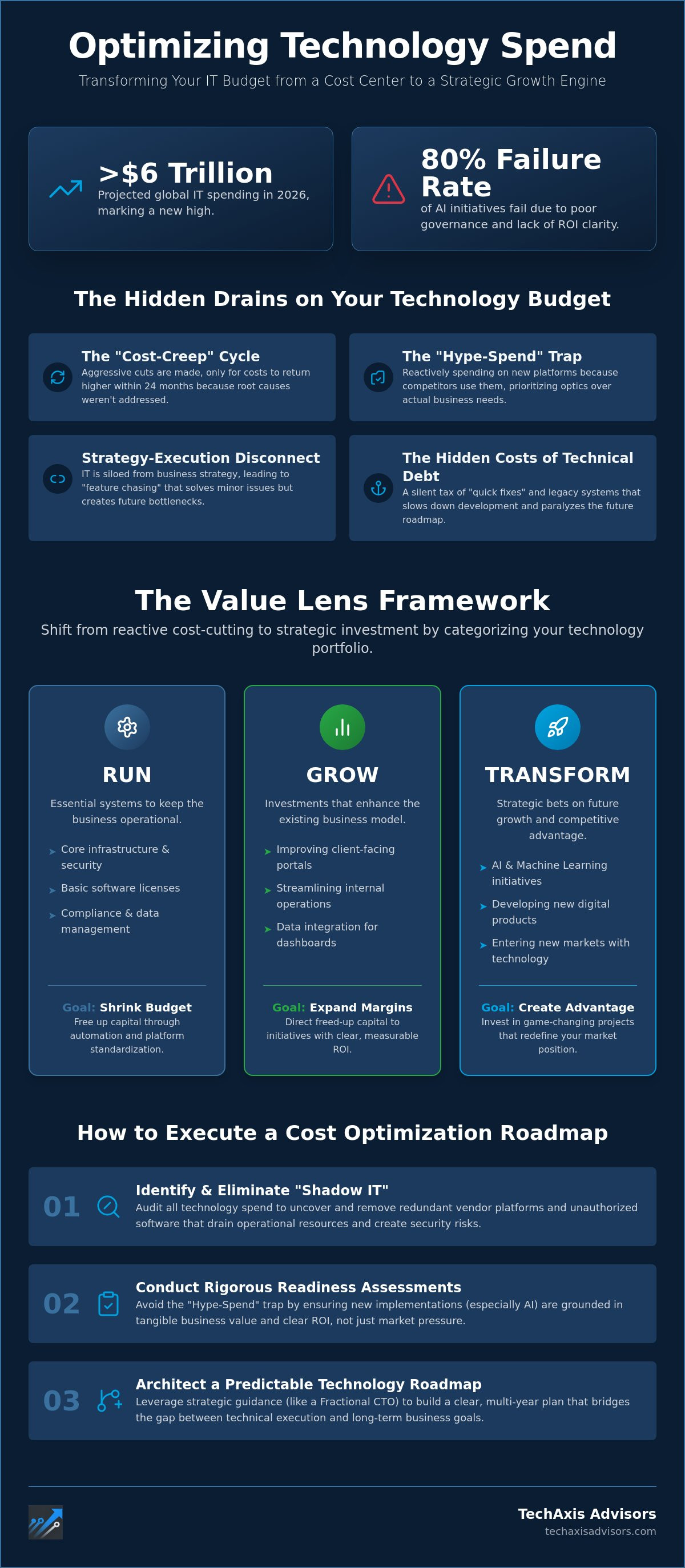
The transition starts by moving away from binary "spend vs. save" conversations. Instead, you must evaluate your technology portfolio through three distinct categories: Run, Grow, and Transform. This framework provides the clarity needed to stop defensive cost-cutting and start offensive resource allocation. It shifts the dialogue from "how much are we spending?" to "what is this spend actually producing for the bottom line?"
Categorizing Your Technology Portfolio
The "Run" category encompasses the essential systems required to keep the business operational. This includes your core infrastructure, security, and basic software licenses. For many growth-stage firms, these costs are bloated by redundant systems and manual processes. You can reduce this baseline through aggressive automation and platform standardization. The goal is to shrink the "Run" budget to free up capital for high-impact work.
Investments in the "Grow" category focus on enhancing your existing business model. This might involve improving client-facing portals or streamlining internal operations to expand margins. In wealth management, for example, this could mean better data integration for advisor dashboards. Finally, "Transform" initiatives are strategic bets on the future. These are projects like AI Advisory & Automation Readiness that aim to create entirely new revenue streams or disrupt your current service delivery model.
Establishing Accountability and Transparency
Transparency is the prerequisite for accountability. You cannot optimize what you cannot see. Board-level reporting must evolve from vague IT line items to clear technology investment summaries. Every major platform or vendor request should require a formal ROI justification that aligns with top-line revenue or margin improvement goals. This creates a culture where technical teams are responsible for business results, not just system uptime.
A Strategic Architect plays a critical role here by vetting technical requests against actual business outcomes. They act as the bridge between high-level strategy and granular execution. By implementing a governance framework that requires measurable KPIs, you ensure that every dollar spent is a deliberate step toward operational maturity. This disciplined approach eliminates the "Hype-Spend" often associated with new technology and replaces it with a predictable, result-oriented roadmap.
Auditing the Invisible: Identifying Technical Debt and Vendor Bloat
Optimizing technology spend for CEOs requires a deep dive into the "invisible" layers of the organization. Most leaders focus on the major contracts visible on the balance sheet. However, the real erosion of margins often happens in the shadows. Shadow IT, the collection of platforms and tools purchased by individual departments without executive oversight, can account for a significant portion of total software spend. These unauthorized tools create security vulnerabilities and redundant costs that quietly drain resources while complicating your data governance.
A rigorous audit begins with vendor consolidation. It's common for growth-stage firms to pay for overlapping capabilities across different SaaS stacks. You might find three different departments using three different project management tools, each with its own seat-based licensing fee. Identifying these overlaps allows for centralized platform management. A disciplined vendor management strategy directly impacts operational maturity by ensuring every tool serves a documented business requirement. By consolidating these accounts, you gain the leverage needed to negotiate better enterprise rates and eliminate "zombie" licenses that no longer provide value.
Evaluating technical debt is equally critical. This isn't just about old code; it's about the financial burden of maintaining outdated infrastructure. You must assess the cost of "keeping the lights on" for legacy systems that no longer support your scaling objectives. Adopting a zero-based approach to technology renewals forces every platform to justify its existence during each budget cycle. If a tool isn't actively contributing to your strategic roadmap, it's a candidate for decommissioning. This approach ensures your budget remains lean and focused on growth rather than historical baggage.
The SaaS Sprawl Challenge
Decentralized software purchasing is a hallmark of rapid growth. While it allows teams to move fast, it creates a fragmented ecosystem that is impossible to govern effectively. Centralizing your platform management doesn't have to mean slowing down innovation. Instead, it involves creating a "paved path" where teams can choose from a vetted list of high-performance tools. This oversight ensures that you maintain control over your data and your margins as you scale. It transforms software from a chaotic expense into a managed asset.
Evaluating Technical Execution Risk
Execution risk is often hidden in single points of failure. This could be a legacy vendor with no clear roadmap or a single developer who holds the "keys to the kingdom" for a mission-critical system. Research from major consultancies like BCG suggests that 70% of digital transformations miss their ROI targets, often due to poor execution rather than bad technology. You can mitigate this risk by leveraging specialized white-label partnerships for custom software development. These partnerships provide the technical depth and governance required to ensure that new implementations deliver on their financial promises without the overhead of a massive internal team.
How to Execute a Cost Optimization Roadmap for 2026
Execution is where strategy either delivers measurable value or becomes a permanent liability. For a growth-oriented leader, the roadmap for the coming year must be proactive. It isn't enough to react to monthly variances in the IT budget. You need a structured process that aligns every technical resource with your operational objectives. Optimizing technology spend for CEOs starts with a rigorous five-step execution framework designed for clarity and accountability.
Step 1: Baseline your current spend. Map every software license, cloud instance, and infrastructure cost to a specific business capability.
Step 2: Conduct an AI Readiness Assessment. Verify that your data is structured for ROI before authorizing new AI initiatives.
Step 3: Reprioritize the roadmap. Pivot resources toward projects with the highest margin impact and the lowest execution risk.
Step 4: Implement a lean governance model. Establish a standard vetting process for all new technology requests to prevent future "shadow IT" sprawl.
Step 5: Establish a continuous feedback loop. Schedule monthly strategic reviews between technical leadership and the C-suite to adjust for shifting market demands.
The AI Readiness Factor
Research indicates that AI projects have an 80% failure rate, primarily due to poor governance and data quality issues. Most AI spend is wasted when it's chased as a "shiny object" rather than a tool for operational automation. A pragmatic roadmap identifies high-impact use cases first, such as automated decision support or reporting, rather than experimental generative tools. Clean data is the prerequisite for success. Without a robust data and reporting strategy, your AI investment will likely produce hallucinations rather than actionable insights. If you are unsure where your data stands, an AI Readiness Assessment is the first step to avoiding wasted capital.
Building a Scalable Operating Foundation
Scaling requires a modern data architecture that supports growth without a linear increase in headcount. As you expand, your technology operating model must be robust enough to support national operations while maintaining strict cost controls. This means building compliance and security into the foundation of every project. Treating security as a "bolt-on" cost is a recipe for expensive remediation and increased execution risk later. A scalable foundation ensures that your infrastructure remains a predictable asset, allowing you to focus on market expansion rather than technical troubleshooting. True excellence in optimizing technology spend for CEOs lies in this balance of structural integrity and financial discipline.
Sustaining Efficiency: The Role of Fractional Technology Leadership
Growth-stage firms frequently hit a leadership ceiling. Your "Head of IT" might be excellent at tactical execution; however, they often lack the executive experience required for high-level resource allocation and strategic planning. At the same time, the overhead of a full-time, C-suite executive can be a premature burden on your margins. This leadership gap is where many organizations lose control of their budgets. Optimizing technology spend for CEOs requires a "Strategic Architect" who can bridge the divide between business objectives and technical implementation without the full-time price tag.
A Fractional CTO provides this necessary bridge. They bring the wisdom of a veteran executive to your specific growth challenges. Instead of just managing support tickets, they oversee the structural integrity of your entire tech stack. They ensure that every vendor contract and platform migration is a calculated move toward operational maturity. This leadership model replaces organizational anxiety with a sense of disciplined, results-oriented progress. It allows you to maintain the agility of a modern innovator while operating with the oversight of a seasoned corporate professional.
The ROI of Fractional CTO Services
Hiring a full-time executive involves significant search costs, benefits, and equity. A fractional advisory model offers a more pragmatic alternative. You gain access to high-level strategic confidence on a part-time basis, focusing your capital on execution rather than executive overhead. A fractional partner also provides objective, third-party vetting of vendors and platforms. They don't have internal biases or department-level agendas. This objectivity is vital when fractional cto services are used to vet complex platforms during a rapid scaling phase. They serve as a professional firewall against "Hype-Spend" and vendor bloat.
Achieving Long-Term Operational Maturity
Sustainability is the end goal of any optimization effort. You must move your organization from reactive "firefighting" to proactive technology governance. This transition requires a culture of transparency where tech spend is tracked against specific KPIs. When your leadership team understands the mechanics of scaling, technology becomes a predictable asset rather than a runaway cost. The final result is a technology foundation that supports national growth and protects your margins. By integrating fractional leadership, you ensure that optimizing technology spend for CEOs isn't a one-time audit; it's a permanent operational discipline that drives long-term competitive advantage.
Building a Resilient Technology Foundation for 2026
Technology spending in the coming year doesn't have to be a source of organizational anxiety. By shifting your focus from simple procurement to strategic reprioritization, you turn your infrastructure into a powerful lever for growth. This journey requires auditing hidden technical debt and applying a disciplined "Value Lens" to every platform renewal. Optimizing technology spend for CEOs is ultimately about achieving a state of operational maturity where every dollar spent is a deliberate investment in your company's future value.
TechAxis Advisors provides the veteran executive leadership and proven framework needed to navigate this transition. As a Certified Women-Owned Small Business (WOSB), we specialize in helping growth-stage and financial services firms achieve AI readiness and long-term scalability. Schedule an Executive Technology Advisory Consultation with TechAxis Advisors to baseline your current roadmap and reduce your execution risk. Your technology stack should be your greatest competitive advantage. It's time to build a foundation that scales predictably with your vision.
Frequently Asked Questions
What is a reasonable percentage of revenue to spend on technology?
Average technology spending varies by sector; however, growth-stage financial services firms typically allocate between 4% and 10% of their gross revenue. This figure isn't a static rule. It fluctuates based on your specific scaling objectives and the maturity of your current infrastructure. If you're spending outside this range without a clear strategic initiative, your budget likely requires immediate scrutiny.
How do I know if my company is suffering from technical debt?
Your organization is suffering from technical debt if your product release cycles are consistently slowing down despite increased headcount. Another red flag is when your development team spends more than 30% of their time on maintenance and "quick fixes" rather than new features. When legacy systems become fragile enough that a minor update causes cascading failures, your debt has transitioned into a strategic liability.
What is the difference between an IT consultant and a Fractional CTO?
An IT consultant typically focuses on solving a specific, time-bound technical problem or implementing a single platform. In contrast, a Fractional CTO serves as a long-term strategic partner who sits at the executive table. They align your technology roadmap with your business goals. They focus on structural integrity, governance, and the mechanics of scaling rather than just technical troubleshooting.
How can AI readiness assessments help reduce my overall technology spend?
AI readiness assessments prevent "Hype-Spend" by identifying whether your data architecture can actually support ROI-driven automation. Most AI projects fail because of poor data quality or lack of governance. By conducting an assessment first, you avoid investing in expensive tools that your current systems aren't ready to handle. This disciplined approach ensures your capital is only deployed when the technical foundation is secure.
What are the first steps a CEO should take to audit their technology budget?
The first step in optimizing technology spend for CEOs is to baseline every dollar of current expenditure and map it to specific business capabilities. You must look past the major vendor names to find the "Shadow IT" buried in departmental budgets. Once you have a transparent view of your SaaS sprawl, you can identify redundant platforms and begin the process of vendor consolidation.
How do I reduce technical execution risk in a growth-stage company?
Reducing technical execution risk requires a combination of strong governance and specialized technical oversight. You should implement a framework that requires clear ROI justification for every new implementation. Additionally, leveraging white-label partnerships for custom development can provide the veteran expertise your internal team might lack. This reduces the likelihood of failed transformations that consume capital without delivering value.
Can technology spend optimization happen without cutting my headcount?
Optimization often focuses on eliminating vendor bloat and manual process inefficiencies rather than reducing headcount. By automating repetitive tasks, you allow your existing team to focus on high-value initiatives that drive revenue. The goal is to increase the output per employee. This improves your margins and operational maturity without the disruption of organizational downsizing.



Comments