

Software license management practices for controlling costs
License spend is rarely controlled by purchase records alone. Effective software license management practices connect what the organization owns with what is installed, actively used, and allowed under each agreement. That alignment gives leaders a clearer basis for managing cost and compliance.
Purchase records matter, but they do not show whether licenses still meet current business needs. Effective software license management practices combine a reliable inventory with usage reviews, clear access and procurement rules, and timely renewal decisions.
This article explains how to build that process: track software and entitlements, compare perpetual, subscription, and usage-based models, reclaim and reallocate unused licenses, and use evidence to prepare for renewals. It also explains why software asset management and license management work best as connected disciplines, not separate administrative tasks.
Table of Contents
Aligning License Management with Business Priorities
Software asset management and license management answer different questions. Asset management records the technology an organization has; license management determines what agreements permit. Connecting the two shows whether installed software, actual use, and entitlements align with business needs. A current inventory helps leadership distinguish necessary capacity from unused licenses or applications with overlapping functions. A practical set of software license management practices starts by linking these records to organizational priorities.
Start with business priorities, then assess the software supporting them. For example, a wealth management firm may rely on a portfolio platform for client reporting. Its leaders need to know which teams use the platform, which agreement covers that use, and whether the installed version supports current reporting requirements. The organization’s sector and operating needs shape those decisions, as reflected in the firms and organizations served.
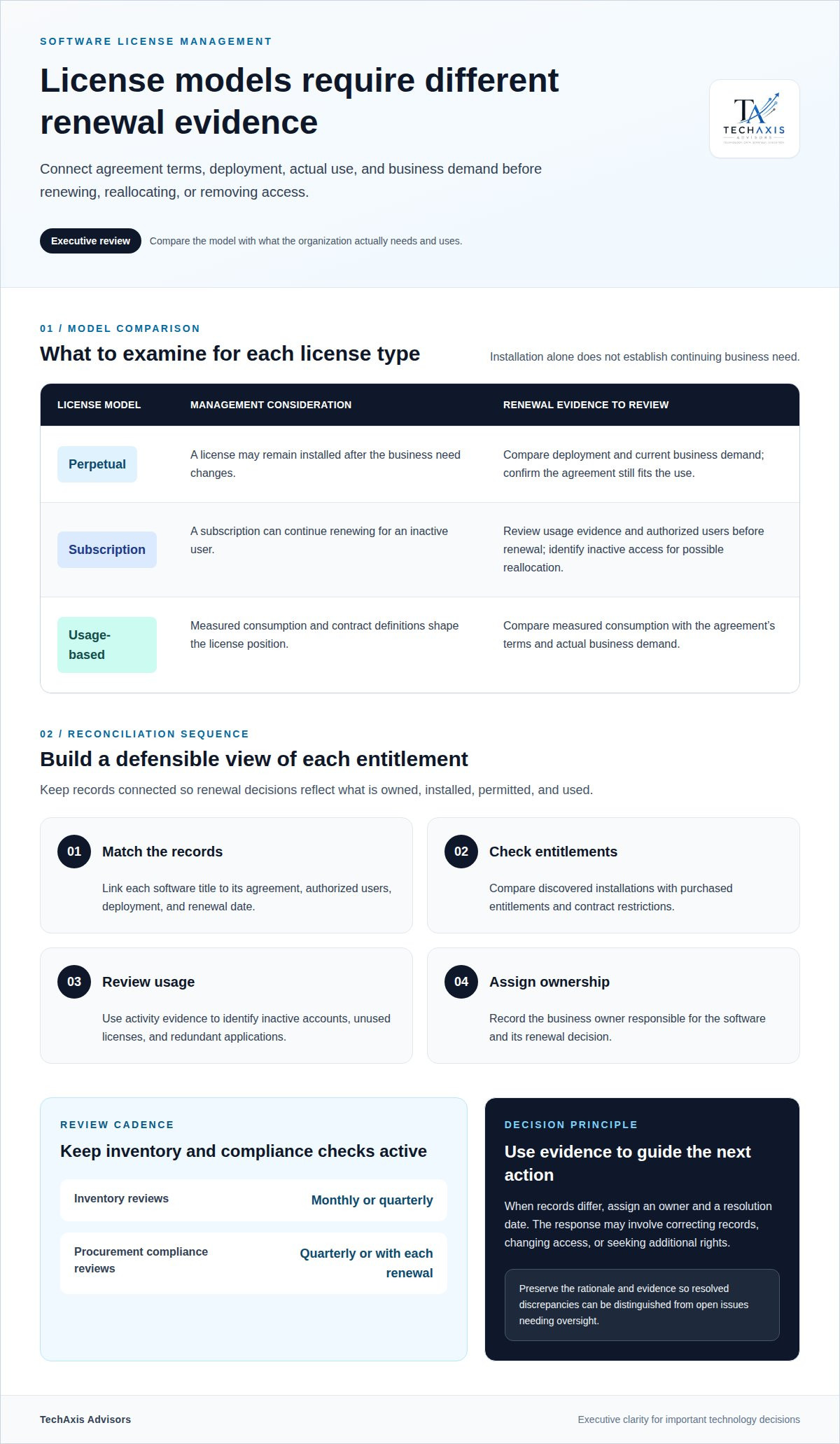
Connect the records in a practical sequence:
Match each software title to its agreement, authorized users, deployment, and renewal date.
Compare discovered installations with purchased entitlements and contract restrictions.
Review usage evidence to identify inactive accounts, unused licenses, and redundant applications.
Record the business owner responsible for the software and its renewal decision.
These comparisons make audits more manageable because the organization can explain what it deployed and why it holds each entitlement. A regularly updated asset inventory helps track software present in the environment, according to the Cybersecurity and Infrastructure Security Agency. Inventory reviews can run monthly or quarterly, while procurement compliance reviews can occur quarterly or with each renewal. This cadence keeps records current without treating a one-time audit as ongoing control.
Licensing models also affect alignment. A perpetual license may remain installed after the business need changes, while a subscription can keep renewing for an inactive user. Usage-based terms require attention to measured consumption and contract definitions. For each model, compare the agreement with deployment and actual business demand before renewing, reallocating, or removing access. Installation alone does not establish continuing need.
Consider a department that has moved to a shared reporting platform but still retains separate analysis software. The inventory may show both applications installed; usage and agreement records can reveal whether the second product remains necessary or creates redundant spend. The decision should account for workflow dependencies, contract restrictions, and the cost of changing processes, not just usage data. Apply these practices to connect software choices with business value.
The core discipline is ongoing reconciliation: agreements define permitted use, asset records show deployment, and usage evidence informs business value. When these records remain connected, audits become a management checkpoint rather than the first time leadership discovers a mismatch.
A Decision Framework for Software License Management
Set decision criteria before reviewing individual applications. For each business capability, define its strategic importance, acceptable risk, service owner, and budget authority. Then determine whether current software supports that capability and whether its access controls fit the organization’s operating model. A sound decision framework makes software license management practices part of technology governance, rather than a separate administrative exercise.
Use a central inventory to inform decisions, not make them. Record each application’s accountable owner, purpose, user groups, and operational dependencies. Prioritize reviews when an application supports a critical workflow, has unclear ownership, or is changing significantly. This directs leadership’s attention to consequential decisions instead of treating every software title as equally urgent.
Establish an effective license position by applying each agreement’s terms to the organization’s deployment and use. When records conflict, assign an owner and a resolution date. The response may involve correcting records, changing access, or seeking additional rights. Preserve the rationale and evidence so executives can distinguish a resolved discrepancy from an open issue that needs oversight.
Build compliance into software delivery gates. Before procurement, require a documented business sponsor, funding approval, and review of licensing conditions. Before deployment, confirm authorized access groups and the control owner. Include software access in workflows for onboarding, role changes, and offboarding. These checkpoints reduce reliance on manual cleanup after a project or employee transition.
Software license management tools vary in their discovery, usage metering, contract records, workflow controls, and reporting. Costs depend on the organization’s requirements, scope, integrations, and deployment approach. Compare tools based on whether they support the decisions and controls you need, not feature count alone. A smaller portfolio may be managed with a controlled register; broader or more complex environments may benefit from automated monitoring.
In the United States, noncompliance can create contractual and operational exposure. License agreements may specify fees, restrictions, audit procedures, or other remedies for unauthorized use. The organization may also need to investigate discrepancies and restore compliant access. Since the relevant terms and facts determine the exposure, route material exceptions to accountable legal, procurement, and technology leaders.
Organizations can improve utilization and reduce avoidable spend by reviewing activity, identifying unused access, and returning eligible licenses to a pool. Pair usage evidence with business context before removing access, especially for applications used intermittently or during critical reporting periods. This helps avoid disrupting necessary work.
Measure the program with indicators leaders can act on: utilization by application, unresolved compliance exceptions, software spend by business owner, and renewals completed with documented review. Track changes over time and report progress quarterly. These measures show whether controls support strategy, access remains appropriate, and where management attention should go next.
Comparing License Models and Their Tradeoffs
Perpetual, subscription, and usage-based licenses distribute cost and flexibility differently. A perpetual license grants use under its agreement, often with an upfront purchase; ongoing maintenance or support may be governed separately. This model can suit stable, long-lived software, but the organization still needs to track deployment, permitted users, and restrictions on transferring or installing it.
Subscription licensing shifts the decision to recurring access and renewal terms. A department can add or remove users more readily than with a fixed purchase, but inactive accounts may remain billable. SaaS subscription reviews should compare assigned accounts with actual activity and business need. For example, when an employee leaves, remove their account from access and consider reassigning the license, subject to the agreement.
Usage-based models tie charges or entitlements to measured consumption, such as transactions, capacity, or feature use, depending on contract terms. They can accommodate changing demand, but cost control depends on understanding the measurement method and monitoring consumption. A department with variable workloads should connect usage records to procurement and financial reporting so increased consumption prompts review before renewal.
Usage data also helps explain what the organization is buying. For example, LabStats software and hardware usage data can help an organization compare application activity with device use and departmental needs. Records may show that a licensed application is rarely used on assigned devices, or that a regularly used tool supports a critical workflow. Treat this evidence as an input to decisions, not a substitute for checking agreement terms.
Procurement policies make model selection consistent. Before approval, record the business owner, intended users, required features, licensing basis, renewal conditions, and expected deployment. This helps prevent a department from choosing a low entry cost while overlooking recurring charges or usage limits. Procurement should also route renewal and expansion decisions through the appropriate budget owner.
Enforcement gives those policies operational effect. Apply approved access rules during onboarding, role changes, and offboarding; remove unauthorized installations and review exceptions. A prohibited-software list can clarify what employees may not install, while an approval path gives teams a way to request needed tools. The policy should cover cloud and installed applications, including software accessed through personal devices.
To compare models, map each option to demand stability, usage visibility, contract restrictions, and the cost of changing access. A perpetual license may fit predictable, durable use; subscriptions may suit changing headcount; usage-based terms may fit variable consumption when metering is clear. Optimize for the total operating fit, not just the purchase line. Revisit the choice when a department’s workflow, scale, or software environment changes.
Executive Considerations for Renewals and Reallocation
Renewal decisions should begin with evidence, not the vendor’s proposed quantity. Before a software renewal, compare active users, deployment records, business ownership, and agreement terms. If one department has unused accounts while another team needs access, reallocation may fit demand better than purchasing additional licenses.
Make license recovery part of workforce changes. When an employee leaves or changes roles, the responsible team should remove access, record the change, and return the license to an available pool when the agreement allows reassignment. For example, an application owner can review inactive accounts and confirm whether each represents a genuine need before planning renewals.
Renewal visibility depends on complete contract records. Maintain a calendar with each agreement’s expiration date, notice period, renewal terms, owner, and procurement contact. Set reminders early enough for the business owner to review usage, confirm future requirements, and secure budget approval. Automated alerts can flag approaching dates, but an accountable owner must still decide whether to renew.
Prepare for a vendor discussion with a concise evidence pack. Include the current agreement, purchases, deployment, active usage, user changes, support needs, and forecasted demand. If the vendor proposes more seats, compare the request with current assignments and planned staffing. If usage has fallen, use the records to discuss a smaller commitment or a different structure.
Reconcile active assignments with usage and permitted reassignment terms.
Confirm renewal dates, notice requirements, and decision owners.
Review procurement records and spending against current business demand.
Document vendor proposals, negotiated changes, and approval decisions.
Procurement should connect renewal planning with budget cycles and application ownership. For example, a finance team evaluating a subscription needs to know whether the spending supports an ongoing business process or simply continues through automatic renewal. Route proposed changes through the same approval controls as new purchases, and retain the rationale with the contract records.
Automation can support monitoring by notifying owners about expirations, inactive accounts, or assignment changes. It should not automatically renew every agreement without review. A renewal workflow should route alerts to the application owner and procurement, then record the decision to renew, reduce, reallocate, or retire the software.
Track outcomes after each renewal. Compare contracted quantities with deployment and actual use, then record changes to spending and access. These records provide a basis for the next vendor negotiation and show whether reallocation created capacity for another team. The goal is disciplined visibility: renew what remains necessary, correct excess commitments, and preserve access the organization still needs.
TechAxis Advisors: Vendor & Platform Management
TechAxis Advisors’ Vendor & Platform Management helps leaders connect software agreements and vendor decisions with business priorities. It can help when renewal ownership is unclear, platform costs are difficult to explain, or software needs are changing across departments. The focus is executive oversight: clarify the decision, organize the evidence, and establish who owns the next step.
For example, a growing financial services firm may depend on a reporting platform while teams use overlapping applications for related work. TechAxis Advisors can support a structured review of platform purpose, vendor agreements, usage information, renewal timing, and operational dependencies. Leaders can then weigh whether to retain, optimize, integrate, replatform, replace, or retire a tool based on business need and the implications of each option.
Vendor management involves more than a renewal conversation. A sound review connects procurement records, application ownership, contract terms, deployment, and business plans. TechAxis Advisors can help executives establish decision rights and governance for vendor relationships, clarifying who evaluates a proposed change, approves spending, and monitors whether the platform continues to support its intended work.
Clarify the business outcome each platform is expected to support.
Connect agreements and renewal decisions with usage and procurement records.
Define ownership for vendor discussions, approvals, and ongoing oversight.
Assess platform changes against dependencies, operating needs, and strategic priorities.
This support is particularly relevant when leadership lacks a clear view across a portfolio, several teams influence vendor decisions, or technology choices have outgrown informal processes. Fractional CTO Leadership can also help establish technology decision-making and governance when executive-level technology leadership is needed. The right scope depends on the decision at hand, from vendor oversight to broader technology direction.
TechAxis Advisors provides practical advisory leadership to support informed decisions. Its independent perspective does not begin by selling software, pushing a platform, or assuming more technology is needed. For software delivery needs, custom software development and implementation services are available through a white-label partnership. That is separate from vendor oversight; the business case should guide whether to improve an existing platform or pursue a tailored solution.
If license records, vendor commitments, and operational priorities are difficult to reconcile, an executive conversation can clarify the decision and the support it requires. Start a conversation with TechAxis Advisors about your vendor and platform priorities.
Frequently Asked Questions
What practices are important for software license management?
Assign an owner to each application and define a consistent approval path. For example, require a business purpose and budget owner for new software requests, then document exceptions and their review dates.
Are institutions spending too much on licenses?
Some organizations may pay for unused access or overlapping applications. Compare commitments with current departmental needs, and consider whether reassignment or a different access tier would fit without disrupting essential work.
How can compliance improve without slowing access?
Use an approved application catalog for routine requests and a focused review for unfamiliar tools. Clear approval roles and time-limited exceptions help teams get necessary access without leaving controls ambiguous.
How do software delivery and metering work together?
Delivery controls determine who receives access; metering records how they use it. For temporary project access, a review at project close can determine whether access should continue.
How does license management support long-term planning?
It helps leaders anticipate technology needs alongside business changes. A planned department expansion may increase demand for one platform while making another application redundant, informing future investment decisions.
How does usage visibility change renewals?
It helps distinguish genuinely inactive accounts from applications used intermittently. Reviewing activity by team and business purpose gives leaders better context for renewal scope and access decisions.
How often should unused software be removed?
Review the portfolio annually, and reassess sooner after project closures, role changes, or platform transitions. Before removing software, consider process dependencies and data-retention needs, then document the decision.
Practice 1: How do you standardize procurement?
Use one request process that captures business purpose, sponsoring department, required capabilities, and budget ownership. Route requests for approval before purchase and retain the agreement with the application’s ownership record.



Comments