

Technology Leadership for Wealth Management: An Executive Strategic Framework
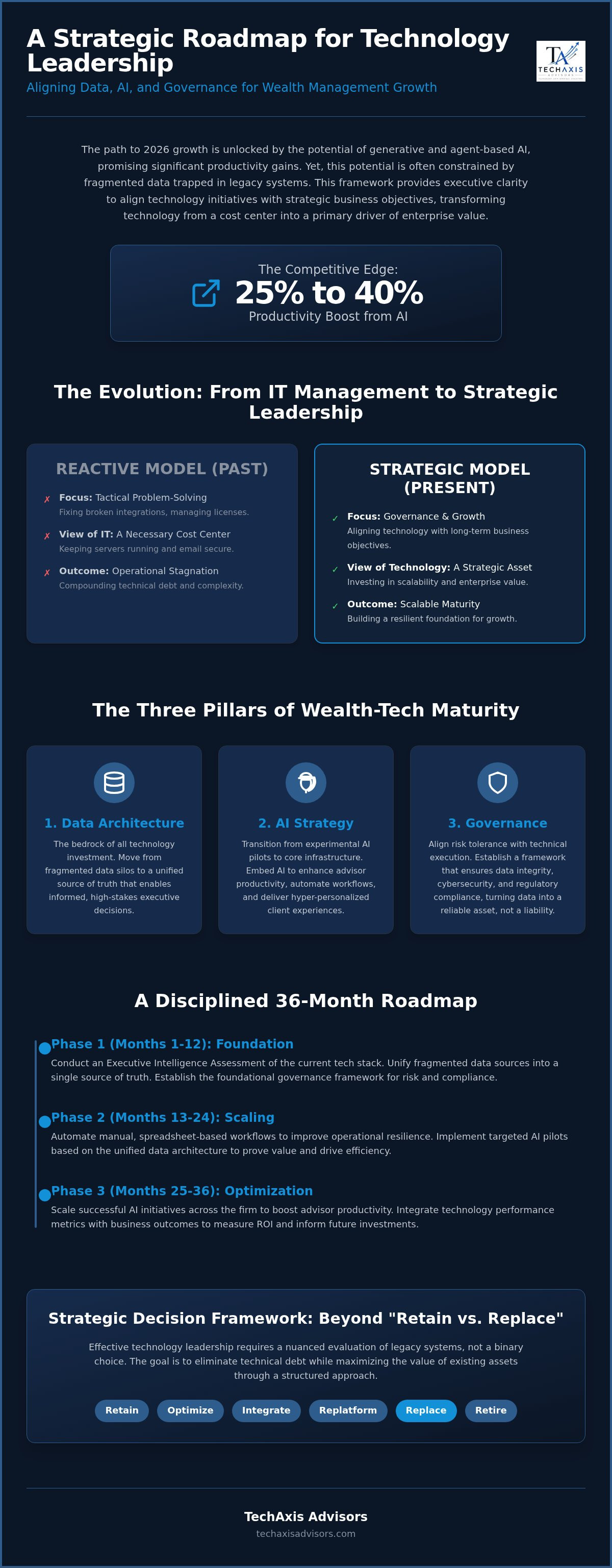
While nearly all wealth management executives expect revenue growth in 2026, the true competitive edge lies in the 25% to 40% productivity boost promised by generative and agent-based AI tools. You likely recognize this potential, yet find your progress inhibited by fragmented data trapped in legacy systems. It's a frustrating paradox. The tools for massive scaling exist, but the roadmap to implement them without compromising fiduciary duties remains elusive. Effective technology leadership for wealth management is no longer just about maintaining servers; it's a strategic imperative that requires high-level oversight and disciplined execution.
This article provides a pragmatic framework for executives to align their data and AI strategies with specific growth objectives. We'll examine how to move beyond the "retain versus replace" dilemma to build an integrated technical infrastructure. You'll learn how to establish a clear governance framework for emerging technologies while reducing execution risk. By following this roadmap, you can transition your firm from operational stagnation to a state of scalable maturity that respects both your time and your capital.
Table of Contents
The Evolution of Technology Leadership in Wealth Management
The role of technology in wealth management has moved beyond the back office. Historically, firms viewed IT as a utility; it was a necessary expense to keep email running and databases secure. This reactive model is now a liability. The evolution of technology in wealth management has shifted technical oversight from the basement to the boardroom. For firms targeting aggressive growth in 2026, technology leadership for wealth management is the primary differentiator between firms that scale and those that stagnate under the weight of their own complexity.
An "IT Manager" approach is no longer sufficient for growth-stage firms. Tactical problem-solving, like fixing a broken integration or managing software licenses, does not address the strategic needs of a modern advisory firm. While 63% of wealth management executives anticipate revenue gains of 8% or more in 2026, achieving these targets depends on three core drivers of evolution:
Client Experience: Moving from product-driven sales to hyper-personalized service delivery powered by data analytics.
Operational Maturity: Transitioning from manual, spreadsheet-based workflows to automated, resilient processes.
AI Adoption: Shifting from experimental pilots to core infrastructure that boosts advisor productivity.
Strategic technology leadership for wealth management focuses on governance rather than just maintenance. It ensures that technical decisions are made with a clear understanding of the firm's long-term business objectives.
From Cost Center to Strategic Asset
Technology is now a primary agenda item for the Board and C-suite because it directly impacts enterprise value. In the first quarter of 2026, wealth management transactions accounted for approximately 75% of total deal volume in the asset and wealth management sector. To maximize valuation, firms must demonstrate a clean technical stack free of crippling debt. Strategic leadership ensures that every dollar spent on software is an investment in future scalability rather than a temporary patch. Firms that fail to bridge this gap often find themselves at a disadvantage during due diligence. You can explore how TechAxis solves technology leadership gaps to ensure your infrastructure supports, rather than hinders, your growth objectives.
The Fiduciary Duty of Technology Oversight
Fiduciary responsibility has expanded to include data integrity and cybersecurity. For three consecutive years, cybersecurity has remained the top concern for wealth management executives. Without centralized technology leadership, firms fall victim to "shadow IT", where departments purchase siloed software that creates security vulnerabilities and fragmented data. This lack of oversight is particularly dangerous given the new regulatory landscape. For instance, the October 1, 2026, compliance date for Form PF amendments requires more detailed reporting on fund structures and exposures. Technology governance is the alignment of risk tolerance with technical execution. It ensures that data remains a reliable asset rather than a regulatory liability.
The Three Pillars of Wealth-Tech Maturity: Data, AI, and Governance
Operational maturity in a growth-stage firm isn't the result of chance. It's the byproduct of a disciplined technical foundation. To achieve effective technology leadership for wealth management, executives must look beyond individual software tools and focus on the structural integrity of their entire ecosystem. This requires a balanced approach to three critical pillars: data architecture, AI strategy, and governance. Without these pillars, scaling asset management becomes a process of compounding technical debt rather than building enterprise value.
Operational maturity is the baseline requirement for firms managing over $5 billion in assets. As regulatory bodies demand more granular data, such as the monthly filing requirements for Form N-PORT, manual processes become a significant execution risk. A mature framework replaces these manual bottlenecks with automated, resilient systems. This shift allows your team to focus on high-value client interactions rather than data reconciliation.
Modernizing Data Architecture
Data is the bedrock of every subsequent technology investment. Fragmented silos across legacy platforms create a "fog of war" that prevents informed executive decision-making. You need a unified source of truth. A modern data architecture ensures that client information, portfolio performance, and compliance records are accessible in real-time. This structural clarity is essential for accurate reporting and fiduciary oversight. For firms struggling with fragmented systems, implementing a TechAxis Data & Reporting Strategy can transform raw information into a strategic asset.
Pragmatic AI Strategy and Governance
AI isn't a trend; it's a mechanism for operational efficiency. According to research on Emerging Technologies in Wealth Management, AI tools could boost productivity by 25% to 40%. However, these gains are only possible if the implementation is governed by a strict risk framework. You shouldn't adopt AI without a clear understanding of your firm's readiness. An Executive AI Readiness Assessment identifies high-impact use cases, from automated client onboarding to real-time compliance monitoring, while ensuring data privacy remains intact.
Effective technology leadership for wealth management requires a governance framework that aligns your risk tolerance with technical execution. This oversight prevents the "shadow IT" issues that often arise when departments try to bypass centralized systems. If your current infrastructure feels disconnected from your growth goals, it's time to evaluate your spend and strategy. If you aren't sure where to start, you might consider how to realign your technical roadmap with your fiduciary objectives through expert advisory.
Strategic Decision-Making: The 'Retain vs. Replace' Framework
Technology leadership for wealth management requires more than selecting the newest platform. It demands a cold, analytical evaluation of your existing ecosystem. Executives often feel pressured to scrap legacy systems entirely, yet a total overhaul is a high-risk move that can disrupt client service and drain capital. A disciplined approach utilizes a six-option framework to determine the most pragmatic path forward: Retain, Optimize, Integrate, Replatform, Replace, or Retire. This rubric ensures that technical decisions align with your firm's growth-stage objectives rather than following industry trends.
The decision to move away from a legacy system usually stems from "Technical Debt." This isn't just a technical term; it's a measurable drag on your firm's agility. You identify it when manual workarounds become the standard operating procedure or when data silos prevent you from meeting new regulatory requirements, such as the monthly N-PORT filing mandates. An evidence-based assessment of your technology operating model allows you to quantify this debt. You must weigh the cost of maintaining an obsolete system against the execution risk of a full-scale migration.
Evaluating Technical Debt and Execution Risk
Quantifying technical debt involves looking at the "silent" costs of operational inefficiency. If your advisors spend 20% of their day reconciling data across platforms, that's a direct hit to your firm's productivity and valuation. While custom software development offers high differentiation, it also carries long-term maintenance burdens. Conversely, off-the-shelf platform consolidation provides stability but may result in vendor lock-in. Understanding who TechAxis serves in the wealth management space can help you determine how your firm's specific needs influence this balance between customization and standardization.
The Framework in Practice
Effective technology leadership for wealth management uses a structured rubric to decide when to salvage a system and when to sunset it. The goal is to maximize ROI while minimizing disruption to the fiduciary process. Vendor and platform management play a critical role here; sometimes, the issue isn't the software itself, but how it's configured or integrated with your other tools.
Replacement is rarely the only, or best, first option for a firm looking to scale. By applying this framework, you ensure that your technical roadmap is built on a foundation of operational reality rather than abstract theory.
Building a Scalable Technology Roadmap for 2026
Strategic execution requires a documented path. A roadmap isn't a wishlist of features; it's a prioritized sequence of investments designed to deliver specific business results. Effective technology leadership for wealth management transforms abstract goals into a concrete, board-ready plan. This process begins with a structured methodology that moves from assessment to implementation. You don't build for the sake of innovation. You build for the sake of scale.
Step 1: Conduct a structured Executive Technology Assessment to establish an objective baseline. Utilizing a proprietary intelligence platform allows you to identify gaps in your current infrastructure without the bias of internal IT teams.
Step 2: Align technology initiatives with specific 12-month and 36-month business outcomes. With 63% of executives anticipating revenue gains of 8% or more in 2026, your technical stack must be the engine of that growth, not a bottleneck.
Step 3: Prioritize the "Action Register" based on risk mitigation and ROI. Address high-risk vulnerabilities, particularly those involving data integrity and cybersecurity, before investing in front-end enhancements.
Step 4: Establish executive governance to oversee vendor selection and implementation. This ensures that new tools integrate seamlessly into your existing ecosystem rather than creating new silos.
Evidence-Based Roadmapping
Roadmaps must be board-ready and grounded in verifiable data. You can't rely on intuition when million-dollar scaling decisions are at stake. A data-driven approach allows you to integrate cybersecurity risk directly into your general technology roadmap; a critical move since security has remained the top concern for wealth management leaders for three consecutive years. For many firms, the complexity of this planning necessitates specialized expertise. Knowing when a growth company needs a fractional CTO can be the difference between a successful transformation and a stalled initiative.
Managing Execution Risk
The risk of failure is highest during implementation. Software transitions and cloud transformations often fail because they lack executive-grade oversight. You must ensure that vendors meet the specific, increasingly stringent compliance requirements of financial services, such as the monthly Form N-PORT filing deadlines. Robust advisory leadership for execution bridges the gap between vendor promises and actual operational reality. This disciplined oversight ensures that technology leadership for wealth management remains focused on tangible business value.
Fractional Leadership: Bridging the Executive Technology Gap
Growth-stage firms often reach a critical inflection point where technical complexity outpaces internal leadership capacity. You need high-level strategy, yet the $300,000 plus salary of a full-time veteran CTO is often unjustifiable for a mid-market firm. Fractional leadership provides a strategic alternative. It offers the caliber of expertise found at Tier 1 global institutions without the associated "prestige tax" or overhead of a permanent executive hire. This model allows you to deploy technology leadership for wealth management with surgical precision, focusing resources on execution rather than administrative bloat.
An independent fractional advisor acts as a Strategic Architect. Unlike large consulting firms that often prioritize their own proprietary methodologies or billable hours, a fractional partner remains objective. They aren't tied to specific vendors or platforms. This independence is vital for maintaining fiduciary integrity. Your technology strategy should be driven by your firm's specific growth objectives; it shouldn't be a byproduct of a consultant's preferred tech stack. This objective oversight ensures that every technical decision serves the long-term interests of your clients and your valuation.
The TechAxis Approach to Fractional CTO Advisory
TechAxis Advisors bridges the gap between high-level business strategy and technical execution. Led by Aarati Dikshit, our advisory team leverages over 25 years of executive experience in wealth management and financial services to drive operational maturity. We don't rely on guesswork. We utilize the proprietary TechAxis Executive Intelligence Platform to provide continuous oversight and data-driven assessments of your infrastructure. This platform ensures that your technical roadmap remains aligned with real-world performance metrics. If you're evaluating different consulting styles, you can learn more about choosing the right technology leadership model for your specific needs.
Moving from Insight to Results
Fractional leaders do more than just deliver a report. They manage the full lifecycle of technical transformation, moving from the initial diagnostic to final execution. This hands-on involvement is critical during high-stakes decisions, such as cloud migrations or the integration of AI-driven compliance tools. A fractional CTO supports the CEO by providing a steady, expert hand during complex implementations; they ensure that vendors meet their contractual obligations and that technical debt doesn't accumulate. Effective technology leadership for wealth management is about delivering tangible results that allow your firm to scale with confidence.
Mastering Strategic Execution for 2026
The shift from back-office IT to strategic technology leadership for wealth management is no longer optional. You've seen that scaling requires more than just adding tools; it requires a disciplined architecture and a board-ready roadmap. By stabilizing your data foundation and applying a rigorous framework to evaluate legacy systems, you eliminate the technical debt that hinders your firm's valuation and agility.
TechAxis Advisors provides the executive-grade oversight necessary to bridge these leadership gaps. Led by a founder with over 25 years of experience as a CIO, CTO, and CISO, our firm utilizes a proprietary Executive Intelligence Platform to replace organizational confusion with disciplined progress. As a certified WOSB and MWBE, we serve as an objective partner deeply invested in your firm's operational maturity and long-term success.
Building a scalable future is a methodical process. We're ready to help you turn technical complexity into a durable competitive advantage that respects both your time and your fiduciary obligations.
Frequently Asked Questions
What is technology leadership for wealth management firms?
It is the strategic alignment of technical infrastructure with business growth and fiduciary duties. This role moves beyond basic IT support to focus on data architecture, AI governance, and operational scaling. Effective leadership ensures that every technical investment directly supports the firm's long-term valuation and compliance requirements. It transforms technology from a back-office expense into a front-office growth engine.
Does a wealth management firm need a full-time CTO?
Not necessarily, especially for mid-market firms managing under $5 billion in assets. While technical oversight is mandatory, the high cost of a full-time executive often exceeds the actual business need. Many firms find that fractional leadership provides the same strategic architect capabilities without the permanent overhead of a C-suite salary. It's a pragmatic way to access veteran expertise.
How does a Fractional CTO differ from an outsourced IT provider?
A Fractional CTO provides executive-level strategy and governance, whereas an outsourced IT provider focuses on tactical maintenance. The CTO role is about the "what" and "why" behind technical decisions that drive growth. The IT provider focuses on the "how" of keeping hardware running. One is a strategic partner invested in your roadmap; the other is a service vendor.
What are the risks of delayed technology modernization in financial services?
Delayed modernization creates crippling technical debt and significant regulatory risk. As bodies like the SEC mandate more frequent filings, such as the monthly N-PORT requirements, firms relying on manual processes face higher error rates. You also risk client attrition. Competitors are already leveraging AI to provide more personalized and efficient service experiences that clients now expect.
How should a CEO evaluate their firm’s AI readiness?
Evaluation starts with a structured Executive AI Readiness Assessment. This diagnostic looks at the integrity of your current data architecture and the maturity of your governance frameworks. You can't implement AI effectively if your data is siloed or your risk tolerance isn't defined. Readiness is about structural integrity and data cleanliness, not just software acquisition or trend-following.
What is a technology operating model assessment?
It is a comprehensive diagnostic of how your firm utilizes technology to deliver value. This assessment establishes a baseline for operational maturity by examining vendor management, data flows, and technical debt. It provides a board-ready roadmap that aligns your technical spend with 12-month and 36-month business outcomes. It replaces organizational anxiety with a clear, disciplined plan for progress.
How can technology leadership improve M&A outcomes for wealth firms?
Strong technology leadership for wealth management increases enterprise value by ensuring a clean, scalable technical stack. During due diligence, buyers look for integrated systems and clear data governance. Firms with low technical debt and automated workflows command higher multiples. They are easier to integrate and carry significantly less execution risk during the transition period.
What is the cost of technical debt in a growth-stage firm?
The cost is measured in lost productivity and missed growth opportunities. Technical debt manifests as manual workarounds that can consume 20% or more of an advisor's day. These "silent" costs drain your capital and prevent you from scaling efficiently. Over time, the expense of maintaining obsolete systems eventually exceeds the cost of a strategic, well-executed modernization.



Comments